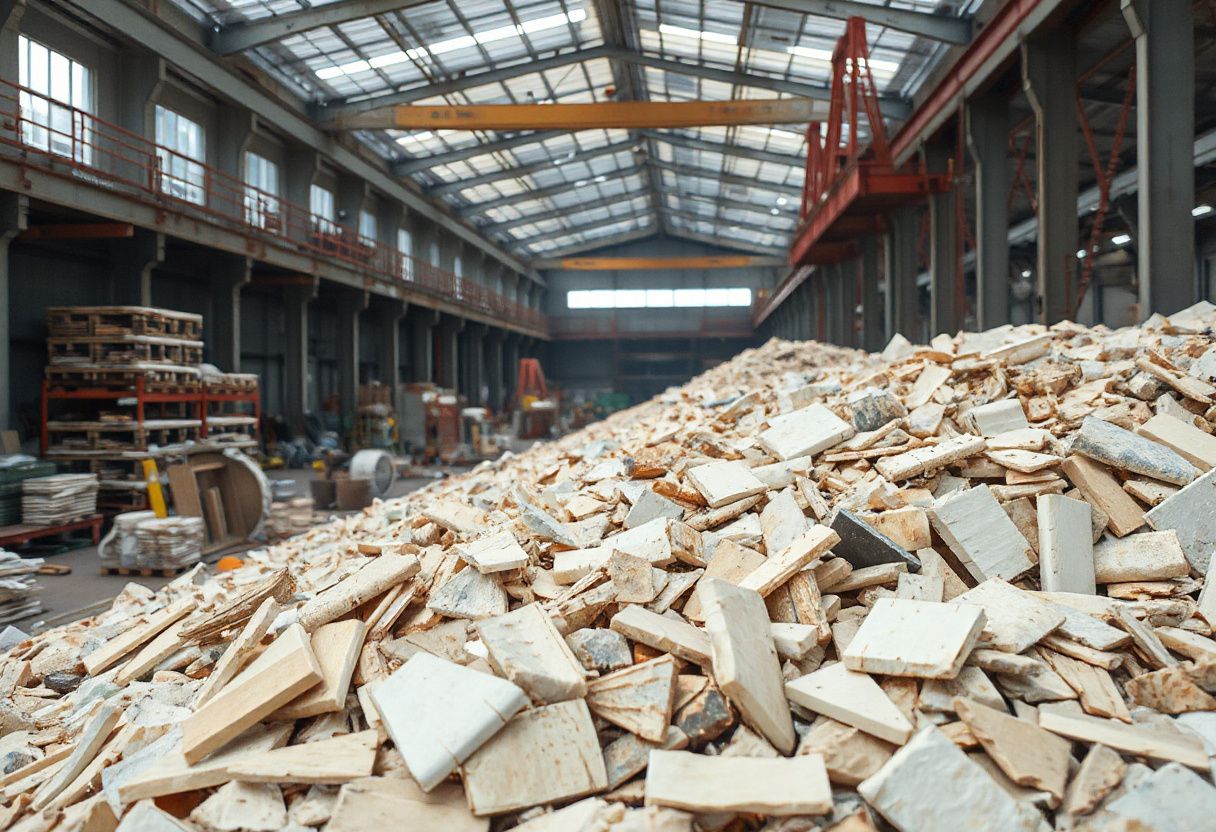
The accumulation of fiberglass scraps at shipyards leads to the rapid cluttering of work areas and an increased fire hazard. Uncontrolled grinding of these materials in the open air saturates the workshops with fine glass dust containing residual monomers. Small particles of glass fiber settle on the rotating components of crane equipment and ventilation grilles, accelerating the abrasive wear of expensive machinery at the shipbuilding enterprise. Long-term storage of spent hull elements in the open air causes toxic compounds to be leached out by rainwater. Liquid leachate containing residual styrene and polymerization accelerators gets into the coastal soils and the water area of the repair base, creating the threat of an environmental fine.
Generation of Polymer Composite Waste During Hull Molding
The production of molded sections for boats, yachts, and military vessels is accompanied by the appearance of technological scraps during the cutting of glass mats. Additional volumes of bulky waste appear during the dismantling of obsolete hulls decommissioned due to intercrystalline corrosion or resource exhaustion. Vacuum infusion molding yields a significant amount of contaminated polymer film and connecting tubes. Cured resin loses its thermoplasticity. Remelting such material becomes completely impossible due to irreversible chemical bonds. Mechanical processing of solidified composites requires the use of carbide milling tools with special cooling.
Classification Codes NPE 07 02 13 and 17 02 04* in Shipbuilding
According to the National Waste List, dry glass fiber scraps and cured polymer residues are classified under code 07 02 13. If the materials are impregnated with uncured resins, toxic catalysts, or contain residues of hazardous solvents, they are classified under code 17 02 04*. The classification determines the further processing route and requirements for special transport packaging.
Specifics of Extracting Toxic Resin Residues
The organization of collection requires the separation of waste directly at the ship component molding site. Large-sized structures are pre-fragmented using hydraulic shears or diamond disc cutting. Dust is captured by industrial cyclones. Comprehensive servicing of shipbuilding shipyards with the removal and processing of these fractions is performed by UtilVtorProm. If specialized equipment is available, transportation is carried out in sealed Multilift-type containers to prevent the spread of hazardous dust particles.
Pyrolysis at 550 °C and Mechanical Shredding of Composites
For the recycling of clean fiberglass, the low-temperature pyrolysis method in oxygen-free reactors at a temperature of 550 °C is used. During this process, the organic matrix is completely gasified, leaving intact strands for the manufacture of structural fiber-reinforced concrete. Alternative mechanical shredding makes it possible to obtain a fine filler for asphalt concrete mixtures. Incineration in high-temperature incinerators at 1100 °C is performed only for fractions contaminated with heavy metals and halogenated additives. A multi-stage gas cleaning system captures acid gases and dust residues. The resulting slag residue after incineration undergoes a vitrification procedure prior to disposal.
Storage of hazardous composite materials on the shipyard's territory requires a closed site with a hard surface. The ingress of moisture into waste with a high content of uncured resin causes partial hydrolysis and the release of harmful gases. The maximum accumulation period for lump scraps in intermediate warehouses of enterprises is strictly limited by compliance with fire safety and sanitary control standards. Fine chips and milling dust are packed into dense polypropylene big bags with a liner. If the containers are not properly sealed, the fine fraction easily rises into the air even with minimal gusts of wind.
The transfer of technological composite residues for specialized processing allows shipyards to avoid the accumulation of hazardous dust in production areas. UtilVtorProm ensures the removal of materials in compliance with environmental standards and provides a full set of acceptance certificates. The enterprise receives a transparent report on the recycling of each batch of fiberglass waste. Rational management of composite materials reduces the environmental risks of the shipyard and guarantees the stable operation of the main shipbuilding equipment.