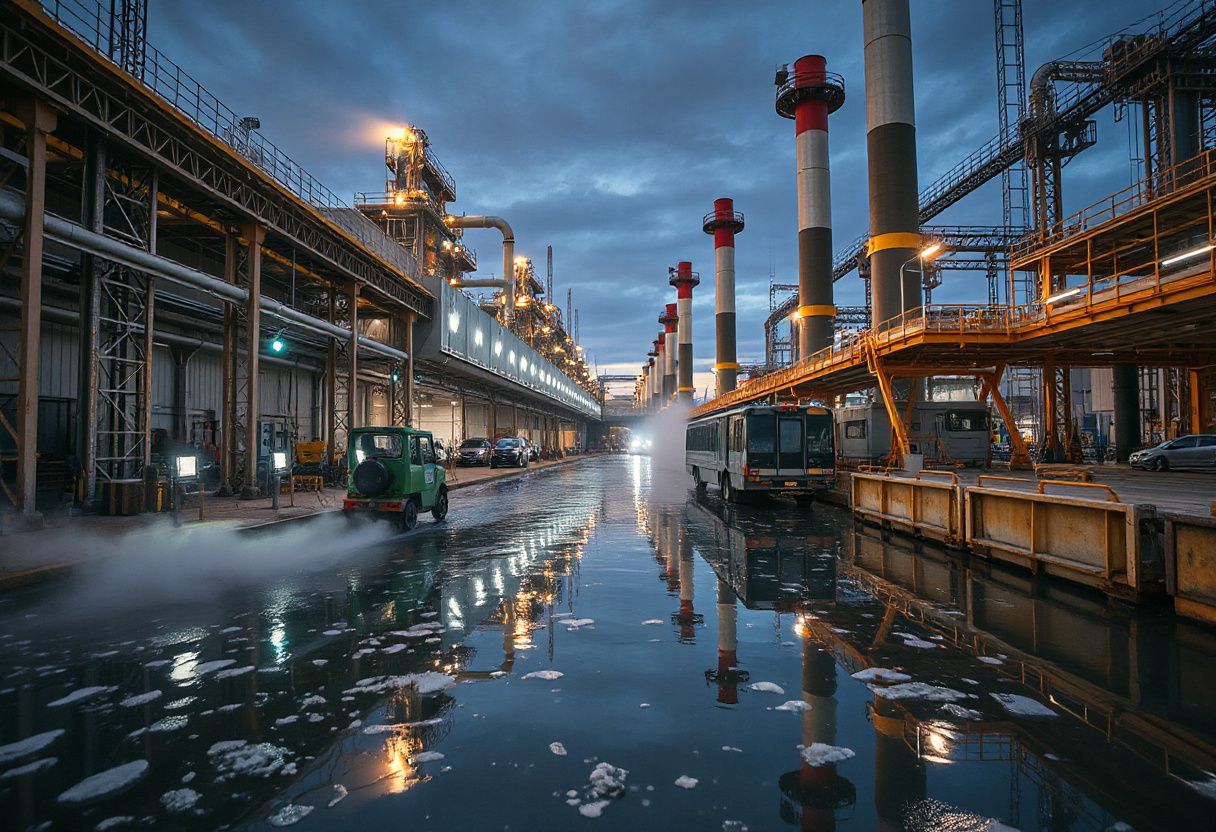
Modern industry and its impact on the environment is one of the most pressing challenges of our time. Constant monitoring and assessment of industrial pollution are key to ensuring environmental safety and sustainable development. Traditional data collection methods are often labor-intensive, expensive, and limited in scope, creating significant obstacles to effective control. In this context, the use of drones, or unmanned aerial vehicles (UAVs), opens up new prospects for collecting accurate and operational data on the state of the environment.
Drones are becoming an indispensable tool in the hands of environmental services and industrial enterprises, allowing them to significantly increase the efficiency of monitoring. They provide access to hard-to-reach or dangerous areas where traditional methods are impossible or associated with high risks. Thanks to their maneuverability, speed, and the ability to integrate with various sensors, UAVs allow for comprehensive information on emissions, spills, landscape changes, and other pollution indicators, which is critically important for timely response and minimization of negative consequences.
Advanced Monitoring Technologies Using Unmanned Aerial Vehicles
The technical characteristics of modern drones used for monitoring industrial pollution are impressive in their diversity and functionality. These devices are equipped with high-precision GPS modules for navigation, powerful batteries that ensure long flight duration, and stabilization systems for obtaining clear data even in difficult weather conditions. The main principle of operation is data collection using integrated sensors, such as gas analyzers, thermal imagers, multispectral and hyperspectral cameras, and laser scanners (LiDAR). These sensors allow detecting and identifying various types of pollutants in the atmosphere, soil, and water.
The composition of the equipment may vary depending on the specific tasks. For example, drones with gas analyzers that can measure the concentration of methane, hydrogen sulfide, and other harmful compounds are used to detect gas leaks. Drones with thermal imaging cameras that record temperature anomalies are used to monitor thermal emissions or oil spills. Multispectral cameras allow assessing the state of vegetation around industrial facilities, detecting changes caused by pollution. The principle of operation involves remote data collection, their transmission to a ground control station, and subsequent processing using specialized software, which allows creating detailed pollution maps and predicting their spread.
Effective Use of UAVs in Industrial Environmental Control
The use of drones for monitoring industrial pollution covers a wide range of industries. In the oil and gas industry, UAVs are used to detect leaks in pipelines, control the condition of tanks, and assess the consequences of oil spills. This allows for prompt response to accidents and minimization of environmental damage. In metallurgy and the chemical industry, drones help control the emission of harmful substances into the atmosphere, monitor chimneys, and detect unauthorized waste discharges. This contributes to compliance with environmental standards and reduces health risks to the population.
In addition, UAVs are effectively used in the mining industry to monitor dumps, quarries, and tailing ponds, assess their stability, and identify potential threats. In agriculture, drones with multispectral cameras help assess the impact of industrial facilities on agricultural land, detecting areas with deteriorated soil and vegetation. Examples of equipment include DJI Matrice 300 RTK drones with integrated FLIR and Micasense sensors, as well as specialized gas analyzers from Dräger. These systems provide high accuracy and reliability of data collection, which is critically important for making informed environmental decisions.
Proper Handling of Spent Drone Components and Their Disposal
Despite numerous advantages, the use of drones raises questions regarding the handling of waste generated during their operation and decommissioning. Such waste includes spent battery packs, damaged electronic components, composite body parts, and other elements. Improper handling of this waste can lead to environmental pollution, as many of them contain hazardous substances such as heavy metals, lithium, and plastics that are difficult to decompose. It is important that this waste is collected, transported, and recycled in accordance with current environmental regulations.
The company UtilVtorProm provides comprehensive services for environmental maintenance of enterprises, including the handling of waste generated as a result of the operation and decommissioning of drones. Such waste may include spent lithium-ion batteries (16 06 01*), electronic circuit boards and components (16 02 13*), as well as composite materials and plastic (17 02 03, 19 12 04). Our specialists provide a professional approach to the collection, transportation, and further processing of this waste, ensuring its safe and environmentally responsible handling. We comply with all legal requirements and use modern technologies to minimize negative environmental impact.
Partnership with UtilVtorProm: A Reliable Solution for Environmental Safety
Cooperation with UtilVtorProm is a guarantee of a professional approach and compliance with all environmental standards in the field of waste management from drone operation and other industrial pollution. Our company has all the necessary licenses and permits for carrying out activities related to hazardous waste management, which confirms our competence and responsibility. We offer individual solutions for each client, developing optimal schemes for the collection, transportation, storage, and processing of waste, which allows enterprises to focus on their core activities, entrusting environmental issues to experienced specialists. By contacting UtilVtorProm, you get a reliable partner who will help ensure the environmental safety of your production and compliance with all regulatory requirements. Contact us today to discuss your needs and get a detailed consultation.