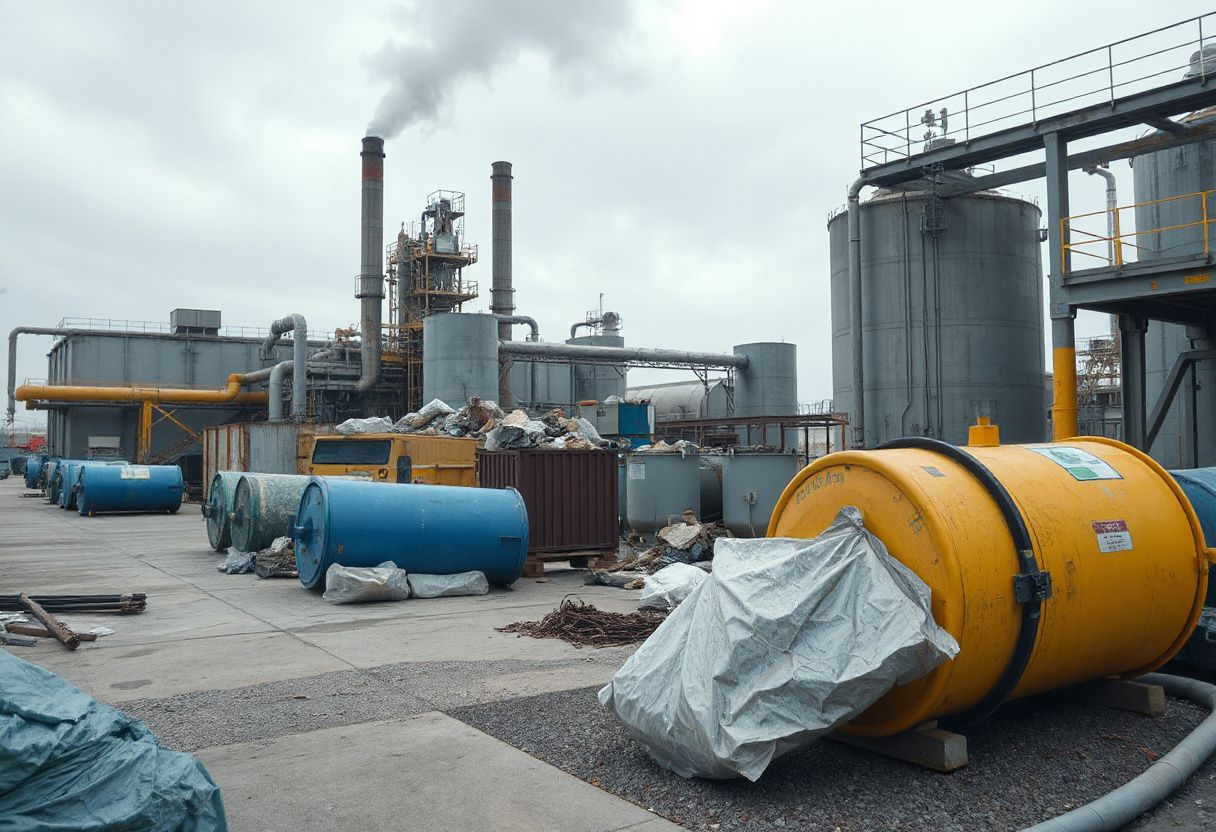
Modern industry faces an increasingly acute problem of hazardous waste processing, which poses a serious threat to the environment and human health. Traditional methods such as landfilling or incineration are often ineffective, expensive, and accompanied by significant environmental risks. That is why the search for innovative and environmentally friendly solutions is becoming a priority for many countries and companies.
In this context, plasma gasification technologies emerge as a promising direction that allows not only neutralizing hazardous substances but also obtaining valuable secondary products such as syngas. This gas can be used as fuel or raw material for the chemical industry, making plasma gasification not only environmentally beneficial but also economically attractive. The implementation of such technologies is a key step towards creating a circular economy and reducing the environmental burden on the planet.
Principle of Operation and Technical Features of Plasma Gasification
Plasma gasification is a thermal process that uses ultra-high temperatures (from 3000 to 10000 °C), created by a plasma torch, to decompose organic and inorganic substances. Waste, entering the plasma zone, decomposes at atomic and molecular levels, transforming into syngas (a mixture of hydrogen and carbon monoxide) and inert slag. This process occurs in oxygen-deficient conditions, which prevents the formation of harmful dioxins and furans, typical products of traditional incineration.
The main advantage of plasma gasification is its ability to process a wide range of waste, including industrial waste, medical waste, hazardous chemicals, and municipal solid waste. The technology ensures the complete destruction of hazardous components, converting them into safe products. The obtained syngas can be used for electricity generation, heat, or as a raw material for synthesizing chemical products, making this method a highly efficient and environmentally friendly solution for waste processing.
Application of Plasma Gasification Technologies for Hazardous Waste Processing
Plasma gasification technologies are widely used in various industries where hazardous waste needs to be processed efficiently and safely. For example, in the petrochemical industry, plasma gasification is used to neutralize spent catalysts, sludges, and other toxic residues. In metallurgy, this method helps process gas cleaning dust containing heavy metals, converting it into safe slag and syngas. Plasma gasification is also promising for processing medical waste containing infectious and pharmaceutical substances, ensuring their complete decontamination.
In addition, plasma installations are used for processing municipal solid waste, which significantly reduces the volume of waste sent to landfills and obtains a valuable energy resource. Examples of equipment include plasma reactors of various designs that can be adapted to the specific needs of an enterprise. These systems ensure high process efficiency, minimal emissions of harmful substances, and the possibility of energy generation, making them an attractive solution for environmentally responsible enterprises.
Effective Management of Plasma Gasification Waste
While plasma gasification technologies are highly effective for processing hazardous waste, it is also important to properly manage the products of the process itself. The main products are syngas and inert glassy slag. Syngas, as noted, can be used as a valuable resource, but its purification from possible impurities is critically important. The inert slag formed as a result of the process is usually non-toxic and can be used in construction or as a filler, which emphasizes the cyclical nature of the technology.
UtilVtorProm provides a full range of environmental services for enterprises, including collection, transportation, storage, and processing of various hazardous wastes that can be treated by plasma gasification. Such wastes include: 16 01 07* (spent filters), 16 03 04* (organic wastes containing hazardous substances), 17 05 03* (slags containing hazardous substances), 18 01 03* (wastes containing infectious substances), 19 01 11* (other wastes from incineration or pyrolysis containing hazardous substances). We ensure compliance with all environmental norms and standards, guaranteeing safe and responsible handling of each type of waste.
Advantages of Cooperation with UtilVtorProm in Waste Processing
Cooperation with UtilVtorProm guarantees a professional approach to solving the most complex tasks of hazardous waste management. We possess all necessary licenses and permits to carry out activities related to the collection, transportation, storage, and processing of a wide range of wastes, including those that can be effectively treated using plasma gasification. Our specialists have many years of experience in environmental safety and apply advanced technologies to ensure maximum efficiency and minimize negative environmental impact. By contacting us, you get a reliable partner who will help your enterprise meet the highest environmental standards and ensure sustainable development. Contact us today to learn more about our services and receive an individual consultation.