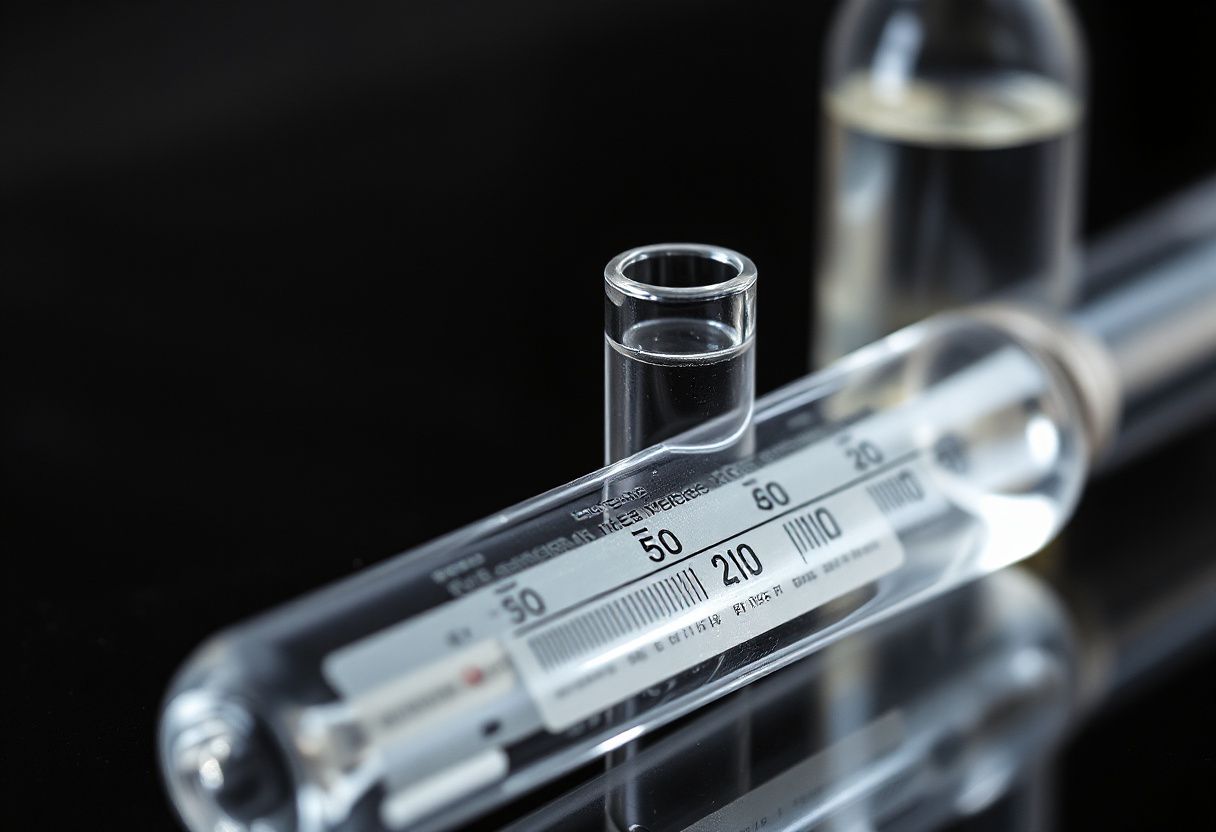
Mercury medical thermometers are sealed glass devices with a highly toxic liquid metal inside. The leakage of the substance poses a serious threat. Recently, a city hospital transferred a batch of several hundred damaged manometers for processing. The facility's staff packed the devices into ordinary cardboard boxes without proper airtight protection. During transportation, the thin borosilicate glass partially deformed, which led to a leak of the toxic phase inside the remnants of the transport packaging in the vehicle.
Errors during waste accumulation at temperatures above 20 °C
Medical institutions often make critical mistakes even at the stage of initial collection of worn-out measuring thermometers and mercury sphygmomanometers in departments. Storing damaged measuring devices in open containers leads to rapid saturation of the room air with poisonous vapor of this toxic metal. In the presence of an elevated ambient temperature, the evaporation rate intensively increases several times. Mixing broken thermometers with household garbage makes safe recycling impossible and creates a direct environmental threat for municipal service workers.
Physicochemical composition and demercurization at 350 °C
A medical thermometer contains about two grams of high-purity elemental liquid mercury. The body is made of durable borosilicate glass, and the capillary tube is made of thin quartz. The metal element remains liquid at room temperature and possesses a high saturated vapor pressure inside any closed volume.
The bodies of complex medical devices often contain parts made of resistant 12Kh18N10T chromium-nickel steel and various non-ferrous alloys. Thermal desorption at 350 °C ensures complete evaporation of mercury films from contaminated metal and glass surfaces of the elements. The resulting glass residue after disinfection is subject to crushing and further processing into building materials. Carrying out thermal cleaning requires the use of special BAU-A grade carbon filters for reliable capture of all residual gases in the system.
Thermal desorption in a vacuum unit and metal regeneration
The technological processing process includes vacuum distillation of the collected mercury mass in a special reactor. The purified liquid metal is sent for reuse in the chemical industry.
For the processing of toxic substances, specialized enterprises use airtight demercurization complexes with a multi-level exhaust ventilation and cooling system. The licensed enterprise UtilVtorProm carries out complete processing of hazardous medical devices in compliance with all necessary technological safety and environmental regulations. Is it possible to completely neutralize the risks? Hermetic vapor condensation under a pressure of 2 bar makes it possible to convert the gaseous phase into a liquid state that is safe for transportation.
Classification by NPW codes 18 01 10* and 20 01 21*
Proper documentation of the transfer of spent thermometers is facilitated by the use of the National Waste List. Dental amalgam and its residues are classified under code 18 01 10* as hazardous material. These requirements are mandatory. Other thermometers and devices belong to the category under code 20 01 21*. Correct filling of accompanying acceptance-transfer acts ensures transparent accounting of every kilogram of mercury elements at any medical enterprise or institution. If an institution does not maintain an initial accounting log, this creates grounds for the imposition of penalties during state regulatory inspections.
Transfer of waste for processing and ordering services
To organize the safe disposal of thermometers, one should start by conducting an inventory of all accumulated broken devices in special utility rooms. After determining the exact number of manometers and thermometers, airtight packaging should be prepared for their subsequent safe transportation to the site. UtilVtorProm provides services for the collection, transportation, and storage of hazardous mercury waste. Timely submission of a service application makes it possible to transfer measuring equipment for recycling in accordance with the requirements of current environmental legislation.