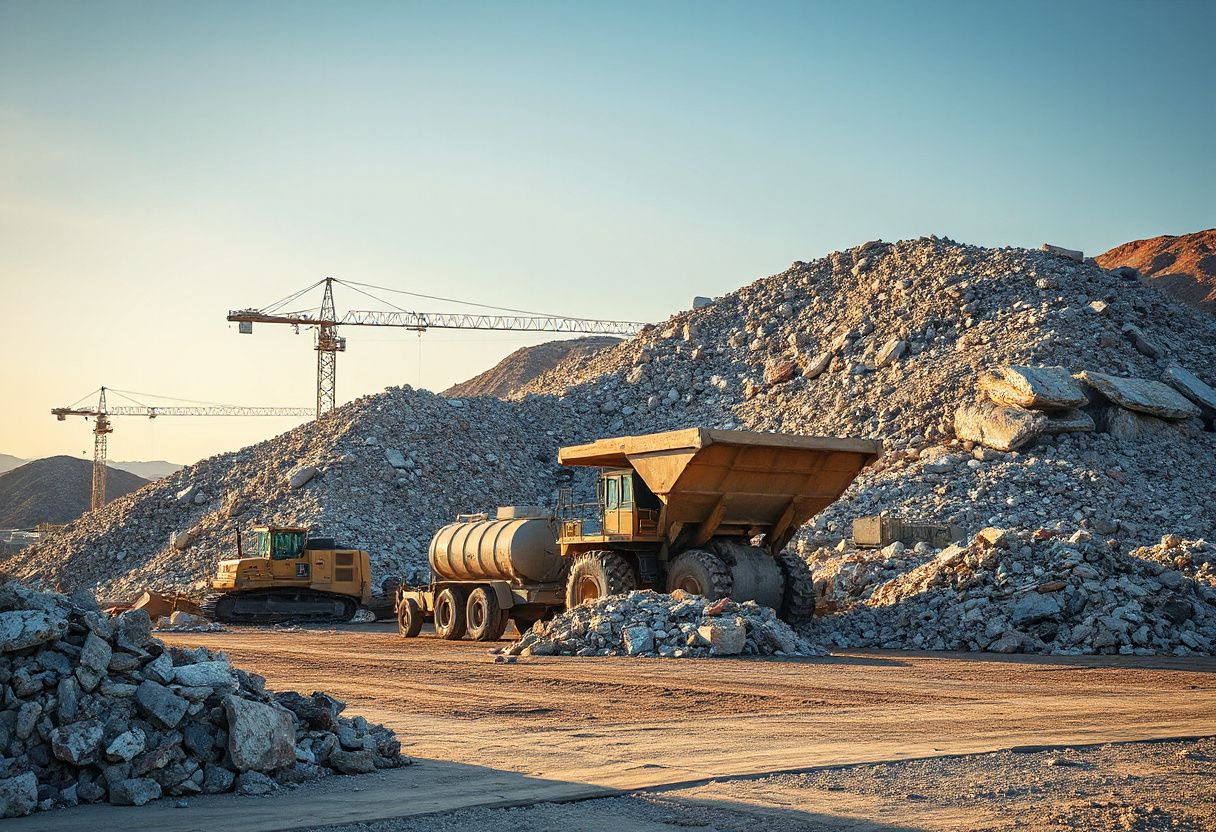
The construction industry has accumulated millions of tons of inert materials at unauthorized landfills for decades, but today state regulators demand strict accounting and mandatory mechanical processing directly at construction sites. The modern industry has moved from spontaneous burial to deep sorting of heavy mineral residues for reuse in road construction cycles. Crushing and classification technologies make it possible to turn the scrap of load-bearing structures into valuable secondary crushed stone of appropriate fractions. Regulated handling of such masses requires a clear understanding of the physical properties of each individual batch of material.
Primary monolithic reinforced concrete has high compressive strength, so powerful hydraulic shears and jaw crushers are used for its destruction. Under normal conditions, the density of heavy concrete is approximately 2,400 kilograms per cubic meter, which complicates transportation over long distances. Small residues of bricks and ceramic blocks have a porous structure and require a different operating mode for setting up rotary equipment. With certain reservations, joint crushing of brick bats and concrete scrap is allowed to obtain low-grade mixtures. Dust generation during the operation of the crusher cannot always be completely suppressed by conventional water nozzles due to the peculiarities of the mineral composition. Enterprises use special magnetic separators to extract the reinforcement cage directly during conveyor transportation.
Classification of materials by NPC code 17 01 01 and 17 01 07
Official classifiers define concrete under code 17 01 01 as a homogeneous material without contamination by hazardous chemical compounds. Mixed construction residues fall under code 17 01 07 in cases where wood, plastic, or mineral wool residues are present in the mass.
Uncontrolled accumulation of construction waste poses a serious threat to upper aquifers due to the leaching of alkaline compounds by rainwater. Improper handling of heavy fraction dust often leads to exceeding maximum allowable concentrations in the working area air. Enterprises are obliged to organize enclosed warehouses for the temporary storage of fine fractions in order to prevent them from being blown away by the wind. Violation of the technology for transporting heavy monolithic blocks is punishable by fines in accordance with the environmental legislation of Ukraine. A responsible engineer designs the processing site with the condition of completely preventing petroleum products from entering the concrete crushing zone.
Operating parameters of mobile crushing and sorting complexes
Initial audit of waste generation at the site demonstrates the actual volumes of raw materials generated for future processing. A technical specialist draws up a waste passport based on laboratory tests of material samples. The enterprise concludes a service provision agreement with a licensed company for the removal and treatment of heavy fractions. Installation of a mobile jaw crusher on-site requires preliminary surface leveling and the arrangement of a crushed stone base. The licensed company UtilVtorProm ensures professional transportation and subsequent processing of heavy construction residues at specialized sites.
The processing line includes vibrating screens for dividing the crushed material into fractions from zero to forty millimeters. Proven equipment demonstrates stable performance at the level of one hundred and fifty tons per hour without overloading components. A powerful magnetic drum extracts metal inclusions with an efficiency of ninety-eight percent for remelting. All processes are accompanied by continuous water irrigation to reduce the concentration of quartz dust in the atmosphere. Engineering control guarantees compliance of the secondary crushed stone with technical specifications for road construction.
Reliable handling of construction residues reduces the load on regional landfills and saves natural resources of extraction quarries. Deep sorting technologies turn construction scrap into a liquid product for the construction of industrial facilities. Modern enterprises are gradually abandoning the disposal of inert materials in favor of their complete mechanical recovery. Every industrial enterprise is obliged to keep electronic records of generated and processed volumes of raw materials. State control in this area is based on the verification of primary acts of transfer of waste to specialized organizations.
Activities in the field of waste management are strictly licensed by the Ministry of Environmental Protection and Natural Resources of Ukraine. Each batch of material is accompanied by a full package of primary environmental documents for submission to regulatory authorities. Modern equipment makes it possible to process up to three thousand tons of heavy residues per working shift. Professional servicing of facilities by specialists of the company UtilVtorProm guarantees complete legal safety and compliance with regulatory requirements.