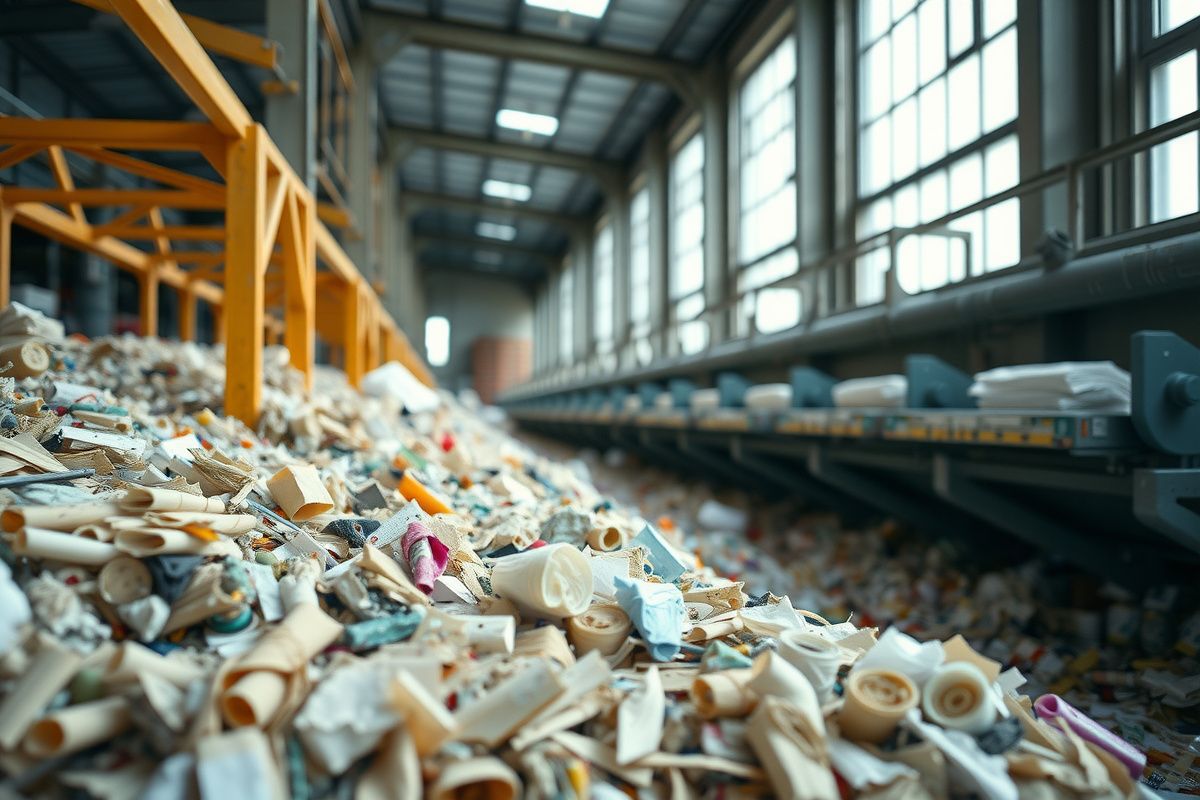
The modern textile industry is one of the largest sectors of the global economy, but at the same time, it generates significant amounts of waste that pose a serious environmental problem. Environmental pollution, depletion of natural resources, and huge volumes of waste in landfills are only some of the negative consequences of uncontrolled use and production of textiles. Therefore, the development and implementation of effective technologies for processing and recovering textile waste becomes an extremely urgent task for all market participants. This not only contributes to environmental protection but also opens up new opportunities for economic development, creating a closed cycle of production and consumption.
UtilVtorProm, as a leading specialist in industrial waste management, actively monitors innovations in this field and offers comprehensive solutions for textile industry enterprises. We understand that each type of textile waste has its own characteristics, and therefore we develop individual approaches to its processing. This allows not only to minimize the negative impact on the environment but also to maximize the effective use of secondary resources, which is a key element of the modern circular economy. Our goal is to help enterprises achieve sustainable development, ensuring a high level of environmental safety and economic efficiency.
Mechanical and chemical methods of textile fiber processing
Technologies for processing and recovering textile industry waste cover a wide range of methods that can be divided into mechanical and chemical. Mechanical processing includes sorting, shredding, and defibration of textile materials. This process allows obtaining regenerated fibers that can be used for the production of new textile products, such as non-woven materials, furniture fillers, or building insulation materials. An important characteristic of mechanical processing is its relative simplicity and low energy consumption, which makes it economically viable for large volumes of homogeneous waste.
Chemical processing methods are more complex but allow obtaining high-quality secondary resources that are not inferior to primary materials in their properties. These methods include polymer dissolution, depolymerization, and pyrolysis. For example, polyester fibers can be depolymerized into monomers, which are then used for the synthesis of new polyester. These technologies require specialized equipment and high safety standards, but they allow processing complex mixtures of textile waste and obtaining valuable chemical products. Both approaches are important components of a comprehensive textile waste management strategy.
Application of recycled textile materials in industry
Recycled textile materials are widely used in various industries, which emphasizes their value as secondary resources. One of the main directions is the production of new textile products, where regenerated fibers are used to create yarn, fabrics, and non-woven materials. This reduces the demand for primary fibers, such as cotton or polyester, and reduces the environmental burden associated with their production. In addition, recycled textile waste is actively used in the production of automotive components, such as sound insulation materials, seat upholstery, and interior elements.
Another important area is the construction industry, where recycled textile fibers are used for the manufacture of thermal insulation materials, sound insulation, and concrete fillers. This contributes to increasing the energy efficiency of buildings and reducing the use of traditional building materials, which often have a significant carbon footprint. Recycled textile waste can also be used as raw material for the production of composite materials, which find application in various industries, from furniture manufacturing to sports equipment. The effective use of these materials contributes to sustainable development and the circular economy.
Environmental management of textile industry waste
Environmental management of textile industry waste is a key aspect for ensuring sustainable development. Textile industry waste can be classified according to different codes of the National Waste List (NWL) depending on their composition and origin. For example, cotton fabric waste that does not contain hazardous substances can be assigned code 04 02 20. Synthetic textile materials that do not contain hazardous substances can be classified as 04 02 21. Textile waste contaminated with hazardous substances, such as dyes or chemical reagents, may have code 04 02 19*. UtilVtorProm provides environmental services to enterprises, ensuring proper sorting, collection, transportation, and processing of this waste in accordance with all environmental norms and standards.
Improper handling of textile waste can lead to soil and water pollution, as well as significant greenhouse gas emissions during their decomposition in landfills. Therefore, it is extremely important to apply a comprehensive approach to their management, which includes not only processing but also minimizing waste generation at the production stages. UtilVtorProm helps enterprises develop and implement effective waste management strategies, which allows not only to comply with legal requirements but also to improve the company's environmental image. Our specialists provide a full cycle of services from waste audit to their safe and environmentally responsible processing.
Professional cooperation with UtilVtorProm in waste processing
By choosing UtilVtorProm as a partner for textile industry waste management, you get a guarantee of a professional approach and licensed activity. Our company has all the necessary permits and licenses to carry out operations for the collection, transportation, storage, and processing of various types of industrial waste, including textiles. We develop individual solutions for each client, taking into account the specifics of their production and the type of waste, which allows achieving maximum efficiency and environmental safety. Our team of highly qualified specialists uses modern technologies and equipment to ensure high quality of services.
We strive for long-term cooperation, building trusting relationships with our clients and offering transparent terms of cooperation. By contacting UtilVtorProm, you can be sure that your waste will be processed in compliance with all environmental standards, which will contribute to environmental protection and improve the image of your enterprise. Contact us today to discuss your needs and get an individual offer for textile industry waste management. We are ready to provide you with a full range of services, from consultations to the implementation of comprehensive processing programs.