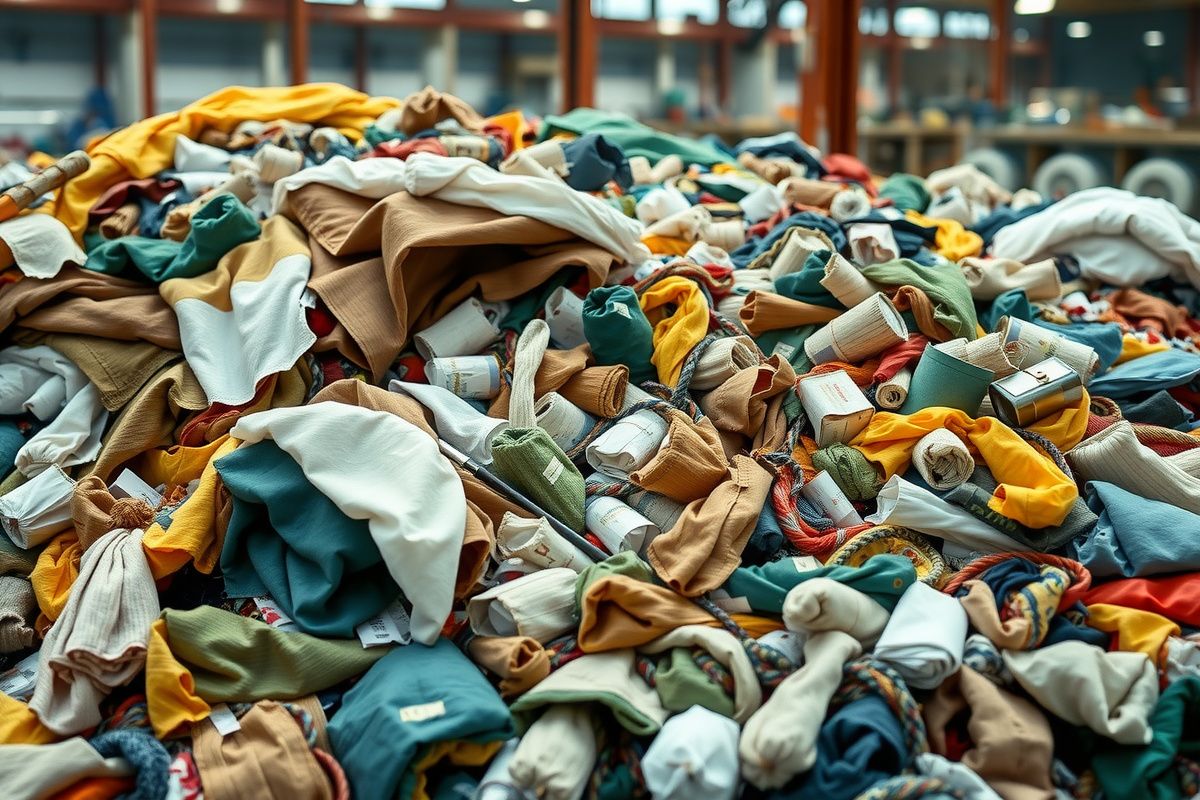
Industrial textile waste is one of the most significant environmental problems of our time, requiring immediate and comprehensive solutions. Annually, millions of tons of textiles generated during the production of clothing, furniture, technical fabrics, and other products end up in landfills, creating a significant burden on the environment and depleting natural resources. This leads to soil and water pollution, greenhouse gas emissions from the decomposition of synthetic materials, and the loss of valuable resources that could be reused. The urgency of implementing effective technologies for processing and reusing this waste grows every year, as society increasingly recognizes the need to transition to a circular economy and sustainable development.
The introduction of innovative technologies for processing industrial textile waste opens up new prospects for the industry, allowing not only to reduce the negative impact on the environment but also to gain economic benefits. This contributes to the creation of new jobs, reduced production costs through the use of secondary raw materials, and increased competitiveness of enterprises. Companies that invest in green technologies demonstrate their social responsibility and attract environmentally conscious consumers. In this context, waste management services provided by UtilVtorProm become a key element for enterprises striving to integrate sustainable development principles into their activities.
Modern methods of fiber regeneration from industrial textile waste
Technologies for processing industrial textile waste include a wide range of methods that allow these materials to be returned to economic circulation. The main approaches are divided into mechanical, chemical, and thermal. Mechanical processing involves grinding textiles into fibers, which can then be used to produce fillers, insulation materials, or new threads. This method is effective for cotton, wool, and some synthetic fibers that do not have significant contamination. An important aspect is sorting waste by fiber type and color, which significantly improves the quality of the final product.
Chemical processing methods are more complex but allow for the production of high-quality fibers, practically identical to primary ones. They include the depolymerization of synthetic fibers, such as polyester and nylon, into their monomers, which are then repolymerized. This process allows for the removal of contaminants and dyes, making it particularly valuable for processing mixed or heavily contaminated textile waste. Thermal methods, such as pyrolysis and gasification, are used to convert textile waste into energy or chemical products, which is an effective solution for materials that cannot be processed by other means, similar to how "Alternative fuel (including mixtures)" can be obtained from various wastes.
Innovative application of recycled textile materials
Recycled industrial textile waste finds wide application in various industries, demonstrating its versatility and economic potential. In the construction sector, it is used for the production of thermal and sound insulation materials, fillers for concrete, and composite panels. In the automotive industry, recycled textiles are used to create interior upholstery, sound insulation, and seat elements, which helps reduce car weight and improve their environmental friendliness. The use of such materials helps reduce the consumption of primary resources and the amount of waste ending up in landfills.
In addition, new fabrics for clothing and home textiles are made from recycled fibers, which is a vivid example of a circular economy. Even contaminated textile materials, such as wiping rags, can be processed for certain purposes, which resonates with the topic "Absorbents, filtering materials, wiping cloths and protective clothing NPC Code 15 02". Modern equipment, including specialized shredders, fiberizers, and chemical reactors, allows for efficient processing of various types of textile waste, transforming them into valuable raw materials for further production. This opens up new markets and opportunities for innovation in the textile and related industries.
Environmentally safe handling of industrial textile waste
Proper handling of industrial textile waste is critically important for minimizing its environmental impact and ensuring the sustainable development of enterprises. Depending on their composition and degree of contamination, textile wastes can be classified under various National Waste List (NPC) codes. For example, clean textile fibers and trimmings may belong to code 04 02 21 (textile fibers not containing hazardous substances), while contaminated textile materials, such as impregnated textiles or rags with hazardous substances, may be classified as 15 02 03* (absorbents, filtering materials, wiping cloths and protective clothing contaminated with hazardous substances) or 04 02 09* (waste composite materials, e.g., impregnated textiles, containing hazardous substances).
UtilVtorProm provides a full range of environmental services for enterprises, including collection, transportation, storage, and processing of industrial textile waste. Our professional approach guarantees compliance with all environmental norms and standards, which is a prerequisite for safe and responsible waste management. We help enterprises correctly identify and classify their waste, develop optimal collection schemes, and ensure its subsequent processing, minimizing the burden on the environment and contributing to the preservation of natural resources. This also includes handling specific materials, such as those containing "Dyes and pigments with hazardous substances," which require special attention.
Partnership with UtilVtorProm for effective textile waste management
By choosing UtilVtorProm as your partner for industrial textile waste management, you receive a guarantee of a professional approach and compliance with all environmental requirements. Our company holds all necessary licenses and permits for waste management activities, ensuring the legality and transparency of all processes. We offer customized solutions developed taking into account the specifics of your enterprise and the volumes of waste generated. Contact us today to discuss your needs and receive expert consultation on effective and environmentally safe processing of industrial textile waste. Let UtilVtorProm become your reliable partner on the path to sustainable development and environmental preservation.