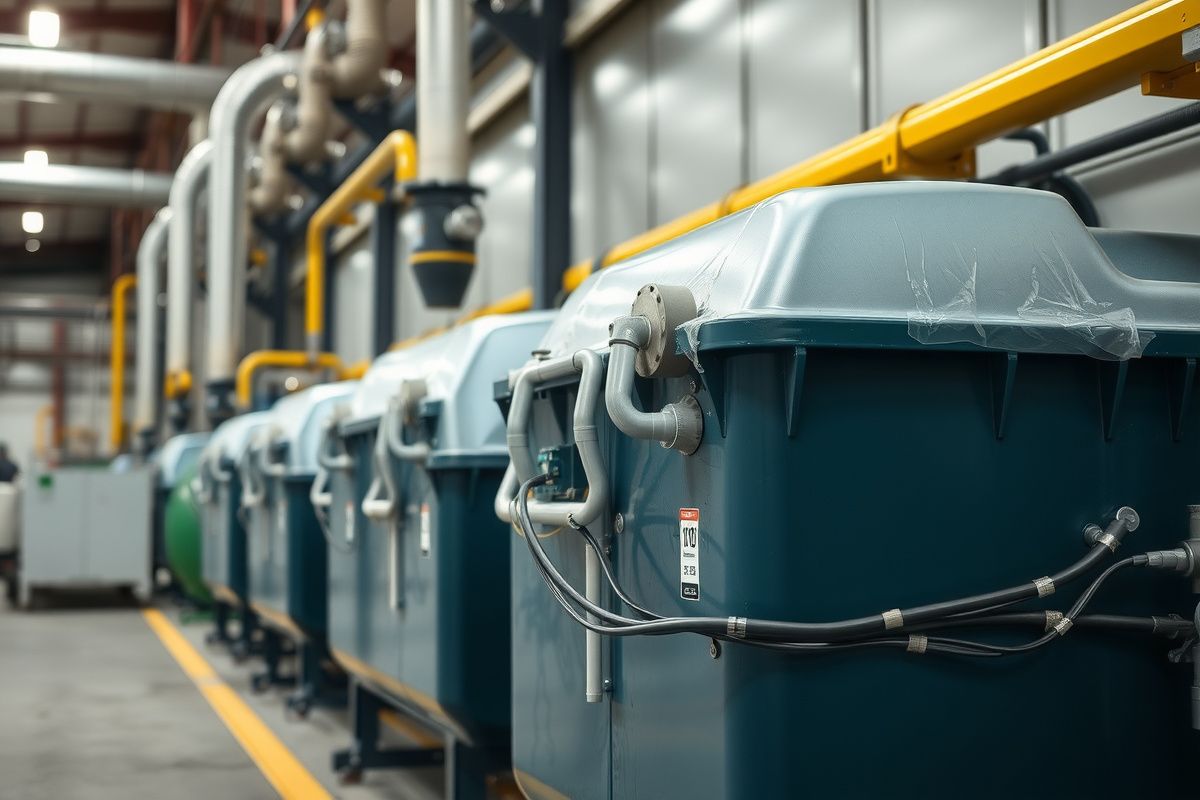
In the context of rapid industrial development and increasing environmental requirements, effective waste collection and processing systems at industrial enterprises are becoming not just a desirable option, but a critical necessity. Modern production processes generate a wide range of waste, from solid household waste to highly toxic industrial waste, which requires qualified and responsible handling. Failure to comply with norms and standards in this area leads not only to significant financial penalties, but also to irreversible negative consequences for the environment and public health. That is why investments in advanced technologies and comprehensive solutions for waste management are a strategically important step for any responsible enterprise striving for sustainable development and minimizing its environmental footprint.
The relevance of this topic is also reinforced by the growing scarcity of natural resources and the pursuit of a circular economy, where waste is considered a potential raw material for recycling. The implementation of innovative systems not only reduces the volume of waste sent to landfills but also allows the extraction of valuable components that can be reused in production, significantly increasing the economic efficiency of the enterprise. This also contributes to enhancing the company's reputation as an environmentally conscious market player. Ensuring safe and effective handling of various materials, such as "Alternative filter materials and used absorbents" or "Waste oils," requires a deep understanding of their specifics and the application of specialized technologies.
Key Technological Aspects of Modern Waste Collection Systems
Modern waste collection and processing systems at industrial enterprises are complex engineering solutions that include several interconnected stages: collection, sorting, transportation, processing, and safe storage. The technical characteristics of such systems vary depending on the type and volume of waste, but the general trend is automation and integration. A typical system may include: specialized containers and bunkers for separate collection, conveyor lines for transportation, presses and compactors for volume reduction, separators for fraction separation (magnetic, optical, air), as well as complex installations for chemical, physical, or biological processing. The operating principle is based on minimizing the human factor and maximizing the efficiency of each stage, ensuring a high level of safety and environmental compliance.
An important element is the use of sensor technologies and monitoring systems that track the composition of waste, the fill level of containers, and the efficiency of equipment operation. This allows for prompt response to changes and optimization of work processes. For example, for liquid waste, such as "Anaerobic household-type liquid waste" or "Alternative emulsions," multi-stage treatment systems can be used, including mechanical filtration, chemical coagulation, and biological treatment. For solid waste, especially hazardous waste, sealed collection and transportation systems are used to prevent the spread of harmful substances. The modular design allows systems to be adapted to the specific needs of the enterprise, ensuring flexibility and scalability in the future.
Sectoral Integration of Industrial Waste Treatment Systems
The application of waste collection and processing systems covers almost all industries where waste of varying degrees of hazard is generated. In metallurgical enterprises, for example, powerful aspiration systems are used for collecting dust and slag, as well as installations for processing "Anode waste containing carbon" or metal shavings. In the chemical industry, the safe handling of liquid and gaseous waste, often containing aggressive or toxic components, is a priority. Here, neutralization, evaporation, adsorption, and regeneration systems are used, which allow valuable substances to be returned to the production cycle or waste to be made safe for further handling. Specialized equipment includes reactors, filters, distillation columns, and reverse osmosis units.
In the food industry, where organic waste predominates, bioreactors and composters are actively used to process raw materials into biogas or organic fertilizers, which aligns with the principles of the circular economy. For medical institutions and pharmaceutical manufacturers, "Safe handling of cytotoxic and cytostatic drugs" is critically important, requiring the use of autoclaves, incinerators, or chemical deactivation. The construction industry focuses on processing construction waste, such as "Concrete, bricks, facing tiles, and ceramics," for their reuse as aggregates. In the energy sector, waste treatment systems include installations for purifying flue gases from harmful emissions and handling ash and slag from fuel combustion, optimizing the process, as in the case of "Analysis of fly ash from emulsified hydrocarbon combustion."
Regulatory Framework and Environmental Requirements for Industrial Waste Management
Industrial waste management is strictly regulated by national and international legislation, which requires enterprises not only proper collection but also correct classification and processing. Each type of waste is assigned a unique code according to the National Waste List (NWL), which allows for the identification of its composition and degree of hazard. For example, for contaminated absorbents, filter materials, wiping rags, and protective clothing, widely used in production, the code 15 02 02* is provided. Waste containing hazardous substances is always marked with an asterisk, indicating its increased hazard and the need for special handling methods. For used mineral oils not falling under other categories, the code 13 02 08* is applied. UtilVtorProm company provides environmental services to enterprises, ensuring full compliance with all regulatory requirements.
Correct identification of waste codes is the first and most important step in their safe and effective management. This allows for the selection of optimal processing technologies, minimization of risks to the environment and human health, and ensuring compliance with all licensing conditions. Waste such as "Batteries and accumulators as hazardous waste: effective management for environmental protection" requires a special approach due to the content of heavy metals and electrolytes. Our company UtilVtorProm specializes in comprehensive management of various types of industrial waste, including collection, transportation, storage, and processing, guaranteeing that all processes are carried out in accordance with the highest environmental standards and legal norms. We help enterprises avoid environmental risks and financial penalties by offering reliable and proven solutions.
Integrated Approach to Waste Management with UtilVtorProm
By contacting UtilVtorProm, you gain a reliable partner who will provide a professional and licensed approach to all aspects of industrial waste management. We possess the necessary permits and certificates to carry out activities for the collection, transportation, storage, and processing of a wide range of waste, including hazardous waste. Our team of experts provides a full range of services, from consultations on waste classification and the development of individual management plans to the direct execution of all work related to their disposal and processing. We guarantee transparency at all stages of cooperation, full compliance with legislation, and minimization of environmental risks for your enterprise. Contact us today to discuss your needs and receive a personalized offer that will help your business become more environmentally responsible and efficient.