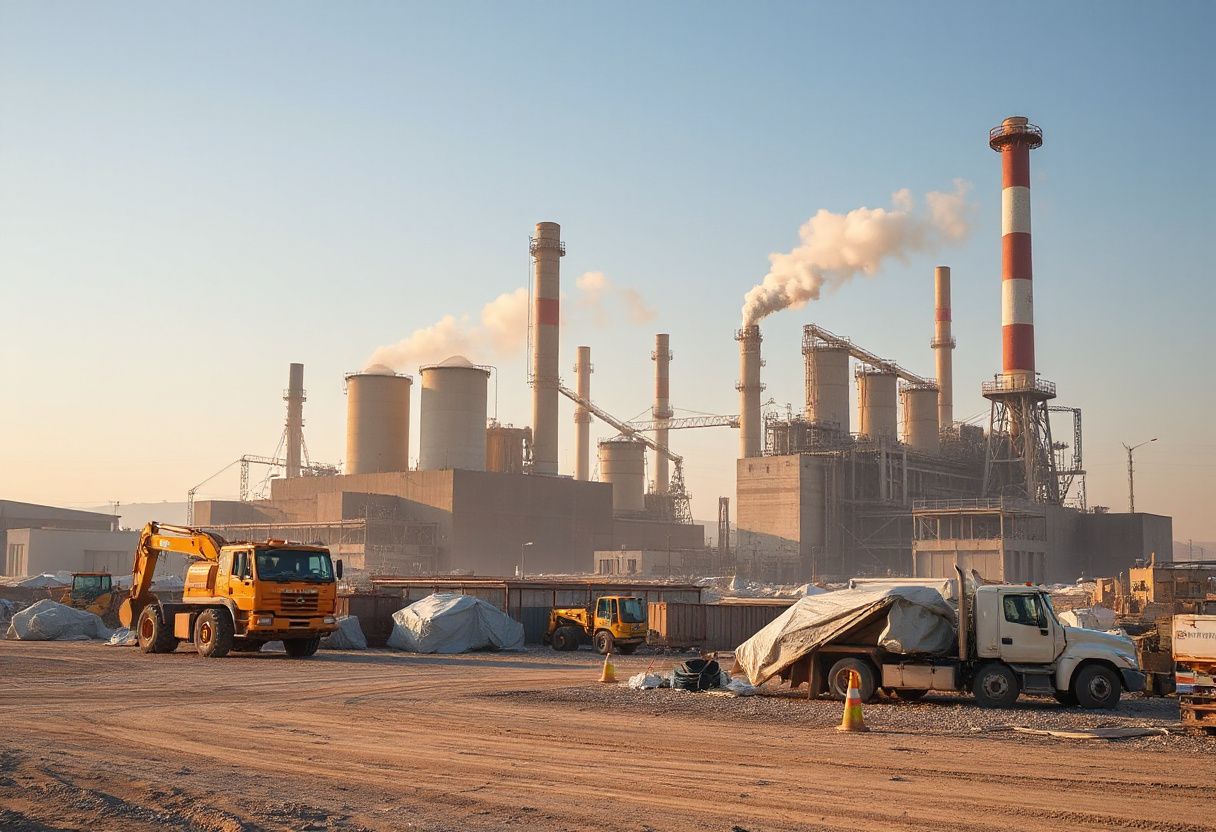
State sanitary norms and rules prohibit the accumulation of hazardous dust during the reconstruction of industrial facilities. Soviet-era building structures often contain a significant amount of chrysotile or amosite fiber. If mechanical destruction of these elements occurs during wall dismantling, microscopic needle-like crystals enter the air of the working area and pose a threat to the personnel's respiratory organs. Current regulations require the immediate localization of such contamination sources directly at the construction site. For the safe execution of work, engineers use special mobile units that create negative pressure in enclosed areas and completely prevent the spread of the dust cloud beyond the site. Mandatory preliminary wetting of structures using binding solutions makes it possible to securely fix hazardous particles in the material's structure before starting its mechanical separation into fractions.
Since the fibers have ultra-high heat resistance up to 1500 °C and resistance to alkaline environments, conventional methods of mechanical grinding cannot change their chemical structure. The chemical composition of chrysotile asbestos is based on magnesium hydrosilicate, which under normal conditions does not interact with most solvents and retains strength for decades. The presence of a cement binding component in slate further complicates the release of pure silicate fibers for further processing. Specialized enterprises, including UtilVtorProm, use acid leaching technology, which destroys the crystal lattice of the mineral using concentrated solutions of hydrochloric or sulfuric acid upon heating.
Thermal destruction at a temperature of 1200 °C
High-temperature roasting in rotary kilns converts hazardous fibers into safe silicate phases, in particular forsterite. This physical and chemical process completely changes the internal structure of the mineral and deprives it of its carcinogenic properties.
Application of plasma-thermal equipment in industry
Thanks to the use of low-temperature plasma with a torch temperature of over 5000 °C, complete vitrification of construction board residues and insulation materials can be carried out. The process requires significant electricity consumption. The silicate slag resulting from plasmochemical treatment has high mechanical strength and can be used as an inert filler for concrete. This approach eliminates the need for long-term storage of hazardous residues in special landfills, as the final product is an ecologically safe raw material. Railway transport and metallurgical plants most often face the problem of accumulating these wastes.
- DC industrial plasmatrons of the DP-100 type;
- Hermetic negative pressure chambers with HEPA H14 class filters;
- High-power mobile aspiration units;
- Hydrodynamic irrigation systems with fine-spray nozzles.
Mechanochemical activation technology is an alternative method for destroying the hazardous fibrous structure without heating. Special planetary mills grind a mixture of mineral raw materials with the addition of chemically active reagents. Under the influence of high local pressures and shear deformations in the crystal lattice of chrysotile, irreversible amorphization processes occur, which lead to the formation of safe compounds. The obtained finely dispersed powder does not contain free fibers and is suitable for the production of dry construction mixes. If the moisture content of the initial raw material exceeds 15%, the grinding efficiency may decrease significantly due to the effect of fine particle aggregation on the working surfaces of the mill.
Waste classification by codes 17 06 01* and 17 06 05*
According to the National Waste List, insulation materials containing hazardous fibers are classified under code 17 06 01* as hazardous substances. Other building materials, including asbestos-cement sheets and pipes, are labeled under code 17 06 05*, which requires compliance with special logistics rules. Transportation is carried out in a closed form. Temporary storage of such materials at the accumulation site is allowed exclusively in hermetic containers or high-strength big-bag type sacks with appropriate labeling.
The enterprise provides a full range of measures for the safe handling of hazardous construction residues. All work is performed on the basis of a state license with strict compliance with environmental standards. After the completion of transportation and technological processing, the customer receives a full package of accompanying documents confirming the transfer of materials to specialized sites. The execution of work completion certificates takes place in accordance with the requirements of the current environmental legislation of Ukraine. In the presence of specific conditions at the dismantling site, specialists develop individual technological charts to minimize dust generation during waste loading. Reliable handling of hazardous raw material residues from the company UtilVtorProm allows enterprises to completely eliminate environmental risks and avoid penalties.