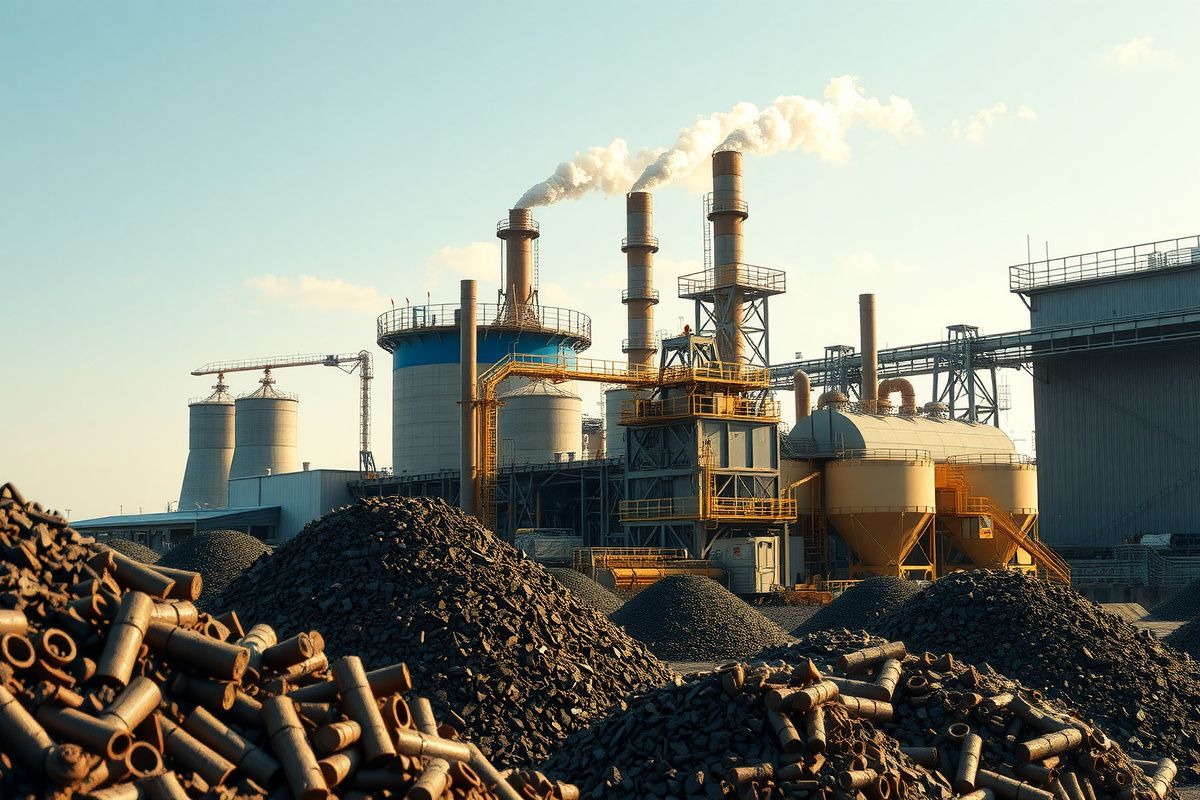
Modern industry faces a dual challenge: increasing demand for raw materials and the need to reduce negative environmental impact. One of the most effective solutions is the development and implementation of environmentally friendly materials derived from industrial waste. This approach not only contributes to the conservation of natural resources but also helps reduce the volume of waste going to landfills, thereby reducing soil, water, and air pollution. UtilVtorProm actively supports and implements the principles of the circular economy, where waste from one production becomes a valuable raw material for another, transforming it into new, useful products.
The relevance of this topic is amplified by growing public environmental awareness and strengthening legislative requirements for waste management. Enterprises that invest in waste processing technologies and the creation of environmentally friendly materials gain significant advantages, including economic benefits from selling new products, improving corporate image, and reducing environmental risks. Innovative solutions in this area open new horizons for sustainable industrial development and contribute to the creation of a more responsible and environmentally safe production cycle.
Transforming industrial waste into high-strength composite materials
Environmentally friendly materials developed from industrial waste often possess unique technical characteristics that surpass traditional counterparts. For example, composite materials derived from metallurgical slags or fly ash can exhibit increased strength, resistance to aggressive environments, and fire resistance. Their composition is carefully optimized using modern scientific developments, including nanotechnologies and chemical modification, to achieve the desired properties. The principle of action of such materials is based on the effective bonding of waste particles using polymer or mineral binders, which form a stable and homogeneous structure.
The process of creating these materials usually involves several stages: collection and preliminary sorting of waste, its grinding to the required fraction, chemical or thermal treatment to remove impurities and increase reactivity, mixing with polymer matrices or other binding components, and forming the finished product by pressing, extrusion, or casting. This allows for obtaining materials with various properties: from lightweight and porous to dense and super-strong, which opens up wide possibilities for their application in various industries. The quality and safety of these materials are confirmed by numerous laboratory studies and certification.
Wide application of secondary polymers and building materials
Environmentally friendly materials created from industrial waste find their application in many sectors. For example, the construction industry actively uses secondary aggregates obtained from construction waste in the production of concrete, bricks, and road pavements. This significantly reduces raw material costs and lessens the burden on natural quarries. The packaging industry is transitioning to using recycled polymers for manufacturing new containers, which is critically important for reducing plastic pollution.
In addition, such materials are used in furniture production, the automotive industry (e.g., for interior trim or sound insulation), and in agriculture for creating drainage systems or soil additives. Waste from the metallurgical industry can be transformed into abrasive materials or components for cement production. The development of new technologies constantly expands the range of possible applications, allowing for innovative solutions for using even the most difficult-to-recycle waste.
Effective industrial waste management: NWL codes and responsibility
Handling industrial waste, which serves as raw material for environmentally friendly materials, requires strict adherence to environmental norms and rules. Each type of waste has its unique code according to the National Waste List (NWL), which determines its classification and handling requirements. For example, metallurgical production waste, such as slags, may have codes 10 02 01* (slag processing waste) or 10 02 02 (unprocessed slags). Construction industry waste, including concrete and bricks, is classified as 17 01 01 or 17 01 02. Spent polymers may have codes 07 02 13 or 16 01 19. UtilVtorProm provides comprehensive environmental services to enterprises, including collection, transportation, storage, and processing of industrial waste in accordance with all legislative requirements.
We ensure full transparency and compliance with all stages of the waste management chain, minimizing risks to the environment and the reputation of our clients. Our specialists conduct waste expertise, assist in their correct classification, and develop optimal schemes for their processing or disposal. This allows enterprises not only to comply with environmental legislation but also to actively participate in creating a circular economy, transforming their waste into valuable resources for further use.
Professional partnership with UtilVtorProm in waste management
UtilVtorProm offers professional and licensed services for industrial waste management, which is a key stage in the development and implementation of environmentally friendly materials. Our experience and modern technologies enable efficient and safe collection, transportation, and processing of various types of waste, transforming them into potential raw materials for new productions. We understand the importance of each stage of this process for sustainable business development and environmental protection. By contacting UtilVtorProm, you gain a reliable partner who guarantees compliance with all environmental standards and regulations. Contact us today to learn more about our services and discuss individual solutions for your enterprise.