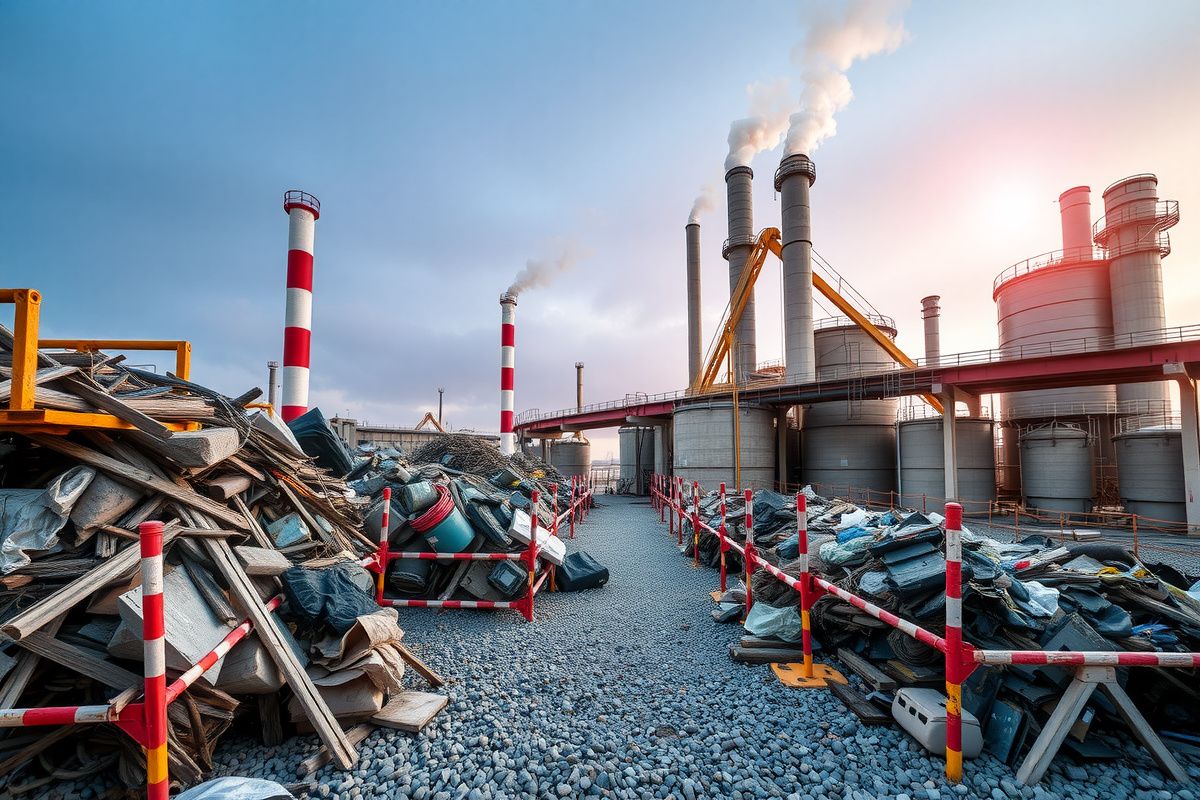
Today's industry faces a dual challenge: a growing need for building materials and the necessity of effective industrial waste management. The development of new materials from industrial waste for the construction industry is not just a trend but a strategic imperative that allows both issues to be addressed simultaneously. This opens new prospects for a circular economy, where waste from one production becomes a valuable raw material for another, minimizing the environmental burden and reducing the cost of extracting primary resources. Such an approach promotes sustainable development, reduces landfill volumes, and creates innovative products with improved properties.
The relevance of this topic is reinforced by growing environmental awareness and strengthening regulatory frameworks for waste management. Companies that integrate industrial waste recycling principles into their production cycles not only demonstrate a responsible attitude towards the environment but also gain significant economic advantages. This includes reducing costs for waste removal and disposal, the possibility of generating additional income from the sale of secondary raw materials, and improving the company's image. UtilVtorProm actively supports and promotes the implementation of such innovative solutions, providing comprehensive services for handling various industrial wastes that can be used to create new building materials.
Innovative composites based on metallurgical slags and ash
New building materials developed from industrial waste often have improved technical characteristics compared to traditional counterparts. For example, composites based on metallurgical slags and ash from thermal power plants demonstrate high strength, resistance to aggressive environments, and excellent thermal insulation properties. Slags formed during metal production contain calcium, silicon, aluminum, and iron oxides, which can act as binders or fillers. This allows for the creation of lightweight concrete, building blocks, and road pavements with increased durability. Ash, in turn, is an excellent pozzolanic additive to cement, increasing its sulfate resistance and reducing shrinkage.
The principle of action of such materials is based on the activation of chemical reactions between waste components, leading to the formation of new mineral phases with high mechanical properties. For example, when using ash and slags in cement compositions, hydration and crystallization occur, forming a strong matrix. The addition of polymer modifiers or special additives can further improve operational characteristics such as water resistance, frost resistance, and fire resistance. This opens up wide opportunities for creating specialized building materials adapted to specific operating conditions, which is an important step towards sustainable construction and efficient resource use.
Application of ecological building materials from waste
Building materials developed from industrial waste find wide application in various industries. For example, lightweight concrete and blocks with the addition of fly ash or crushed construction waste are actively used for erecting walls and partitions in residential and industrial construction. This allows for reducing the load on the foundation, lowering transportation costs, and increasing the energy efficiency of buildings. In road construction, slag materials are successfully used for making bases and pavements, ensuring high strength and abrasion resistance. In addition, recycled glass and plastic waste can be used to produce thermal insulation materials, paving slabs, and decorative elements, which helps reduce waste volumes in landfills.
The application of such materials is not limited to large infrastructure projects. They are also integrated into landscape design projects, where recycled waste is used to create landscaping elements such as curbs, fences, and decorative coverings. In agriculture, for example, some types of waste, such as gypsum from flue gas desulfurization, can be used to improve soils. This demonstrates the versatility and universality of approaches to industrial waste recycling, which allows not only solving environmental problems but also creating new markets for innovative products. The development of waste processing technologies and their integration into production processes is a key factor for achieving sustainable development goals.
Ecological handling of industrial waste for the construction industry
Effective handling of industrial waste that can be used to create building materials is a critically important stage. This requires strict adherence to environmental norms and rules. Such wastes include metallurgical slags (10 02 01*, 10 02 02*), ash and slag from coal combustion (10 01 01*, 10 01 02*), waste from cement production (10 13 01*), gypsum waste (10 13 06*), as well as construction waste (17 01 01*, 17 01 02*, 17 01 03*, 17 01 07*). UtilVtorProm provides environmental services to enterprises, ensuring the collection, transportation, storage, and processing of these wastes in accordance with all current regulations. We guarantee that all processes are carried out with minimal environmental impact, which is the key to a successful cycle of converting waste into valuable resources.
The waste management process includes sorting, purification from impurities, and preparation for further processing. This may include crushing, separation, and chemical stabilization to ensure safety and efficiency of use in the production of building materials. Improper handling of industrial waste can lead to pollution of soils, water resources, and air, so a professional approach is mandatory. UtilVtorProm has all the necessary licenses and permits to work with a wide range of industrial waste, ensuring their responsible and environmentally safe handling, which is the basis for creating high-quality and safe building materials from secondary raw materials.
Partnership with UtilVtorProm: a reliable path to sustainable construction
Cooperation with UtilVtorProm is an optimal solution for enterprises that seek to effectively manage their industrial waste and integrate it into the cycles of production of new building materials. We offer a comprehensive professional approach that includes consultations, logistics, as well as the direct processes of processing and preparing raw materials. Our activity is licensed, which confirms a high level of compliance with all environmental standards and legal requirements. By contacting UtilVtorProm, you get a reliable partner who will help transform your industrial waste into a valuable resource, contributing to the development of sustainable construction and environmental protection. Contact us today to learn more about our services and discuss individual solutions for your enterprise.