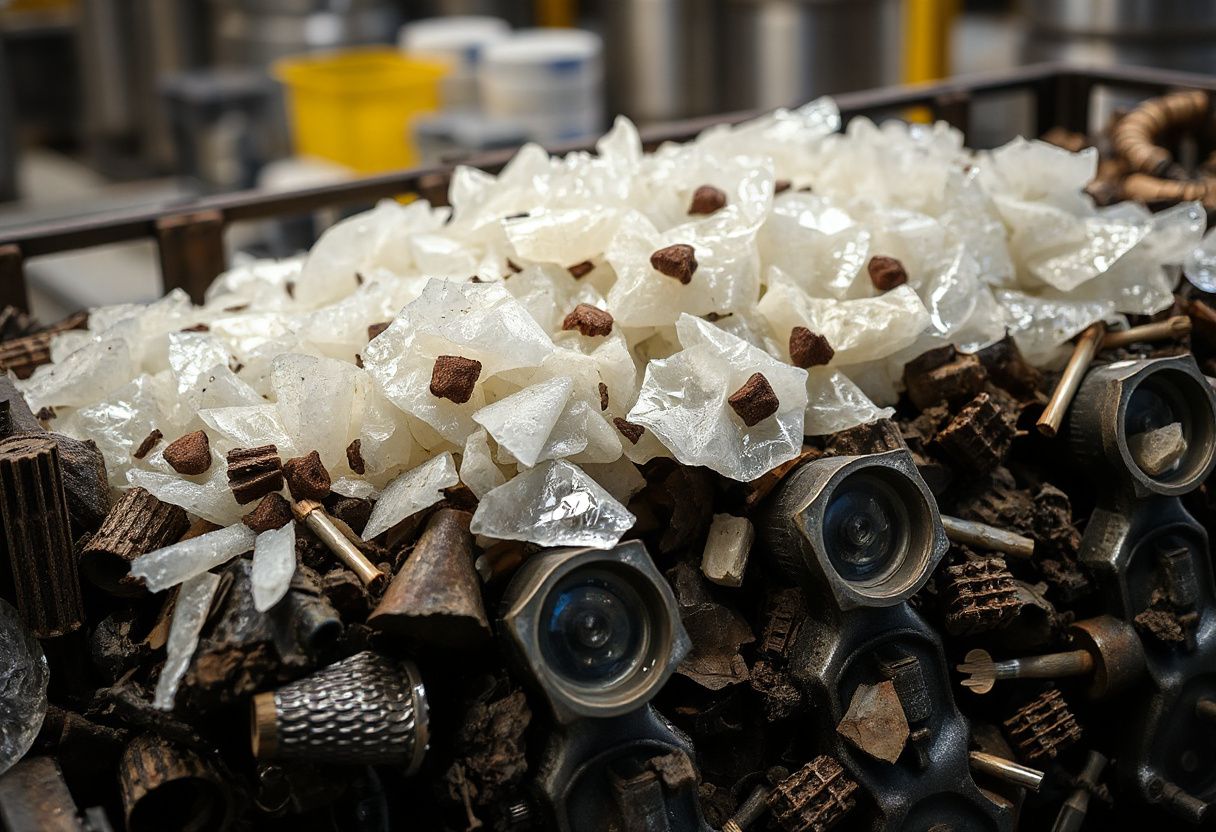
Improper handling of fiberglass in production causes severe fines from the State Ecological Inspection and clogging of filtration systems at landfills. Factories that ignore accounting rules usually receive enforcement orders due to non-compliance with the licensing conditions for storing resinous residues. State inspectors record violations during scheduled inspections of industrial zones. Fines are calculated separately for each cubic meter of unsorted waste. The enterprise's environmental department bears personal responsibility for such incidents before regulatory authorities.
Technologists at large plants often face the problem of accumulating defective parts from composite mixtures after the shift cycle is completed. Therefore, in practice, waste trimmings cannot simply be taken to the nearest municipal landfill due to their specific hazard class. Polymer matrices based on epoxy or polyester resins decompose in the natural environment for centuries without losing toxicity. Specialized companies accept such industrial volumes only if properly executed primary documentation is available.
NEC Codes 07 02 13* and 12 01 05 for Composites
The classification of generated waste requires a clear understanding of the origin of each specific polymer batch. Management of production processes involves entering accurate codes into the monthly declarations of the enterprise. End-to-end accounting is based on the current state classifier.
Artificial fibers are classified according to strict state standards for further transportation. Proper labeling of packaging eliminates confusion in intermediate warehouses.
State authorities require strict compliance with the specified norms when preparing material safety data sheets.
Logistics and Temporary Storage Rules at the Enterprise
The organization of safe scrap collection requires the use of airtight containers or dense big-bags to prevent the weathering of fine dust. Airtight packaging protects the workshop atmosphere from toxic volatile compounds during the prolonged accumulation of a batch.
Logistics companies transport such cargo in specialized covered vehicles in accordance with ADR requirements for hazardous goods. Shipping documents are filled out by the occupational safety engineer before the truck leaves the factory gates.
Stages of Work for Licensed Contractors
The process of transferring raw materials to a third-party organization includes several successive stages of volume control. Factories generally follow a clear interaction algorithm with the licensee.
- The factory commission carries out joint weighing and labeling of packaging with defects.
- Environmentalists sign an agreement for the transportation and subsequent processing of batches.
- The driver picks up the batch upon presentation of the consignment note and license.
- The organization provides a certificate of completed work to close out environmental reporting.
The licensed operator UtilVtorProm provides a full cycle of work with strict compliance with the current legislation of the country. The company's engineers select optimal processing methods for each specific brand of composite.
A reliable contractor guarantees the absence of risks for the customer throughout the entire period of cooperation. Legal support covers all stages from the initial application to the final liquidation of hazardous components in special furnaces. Plant management receives official confirmation of the legal destruction of harmful residues.
Physical Properties and Composition of Polymer Matrices
Fiberglass consists of a reinforcing framework and a binding polymer matrix of varying degrees of density. The content of silicate fiber in such products reaches 70 percent of the total mass of the finished structure. This structure provides high part strength with minimal specific weight.
Thermosetting resins do not melt when heated, which complicates their thermal regeneration by conventional methods. Mechanical grinding of such materials in crushers is accompanied by the formation of harmful micro-dust. Workshop workers are required to use high-protection respirators.
The destruction temperature of the polymer binder is about 450 degrees Celsius. The disposal of such waste requires special equipment with a multi-stage gas purification system.
Comprehensive industrial waste management allows plants to avoid shutting down production lines due to overflowing warehouses. Modern recycling technologies minimize the negative impact of heavy industry on the region's environment. Manufacturing enterprises get a reliable partner to solve daily environmental tasks.