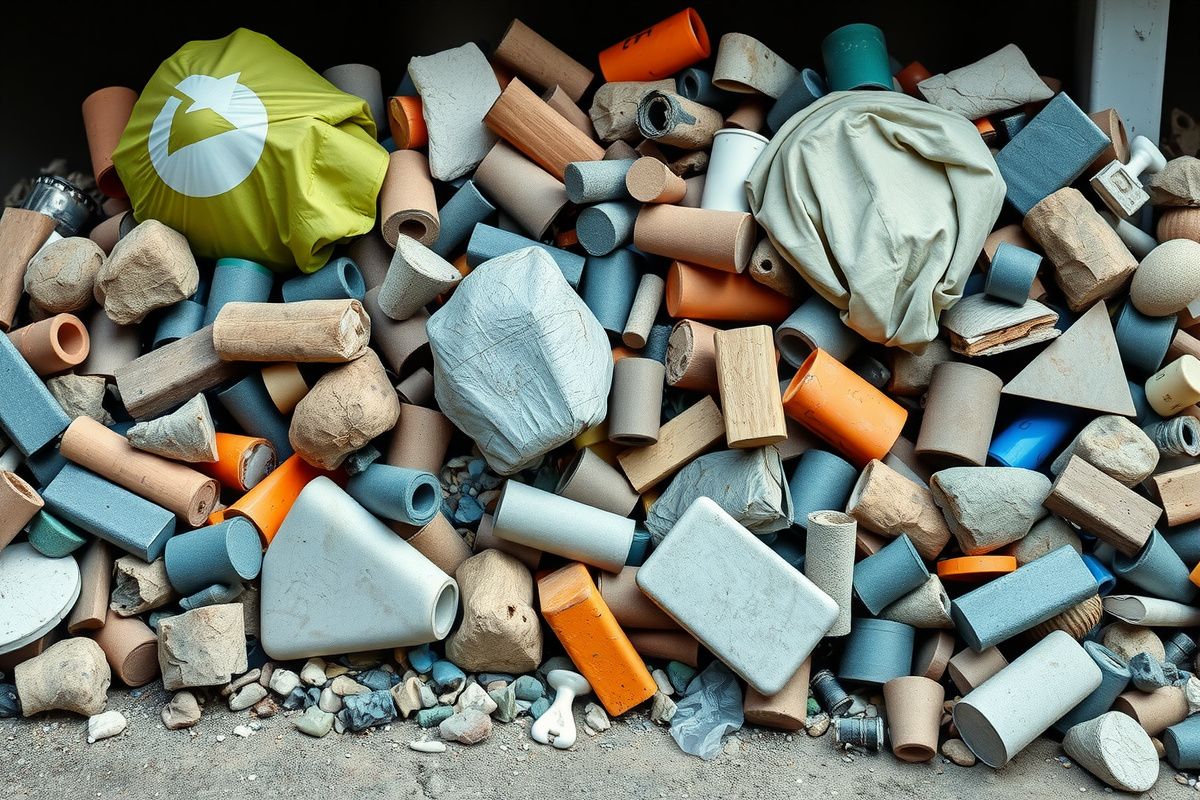
The recycling and reuse of construction industry waste is one of the most pressing topics in the modern world, where there is growing awareness of environmental challenges and the need for sustainable development. The increasing volume of construction leads to a significant accumulation of construction waste, which can negatively impact the environment and deplete natural resources. Effective management of this waste not only reduces the burden on landfills but also opens up new opportunities for creating valuable secondary materials, which helps reduce the cost of producing new building materials and promotes a circular economy. This creates a comprehensive approach to resource conservation and environmental responsibility.
Waste management companies play a key role in this process, offering innovative solutions for collection, transportation, sorting, and recycling. The implementation of modern technologies allows for the transformation of construction waste into high-quality raw materials for new construction, reducing the need for primary material extraction. This approach contributes not only to nature conservation but also to increasing the economic efficiency of the industry, stimulating the development of new markets and jobs in the field of environmental services. Thus, construction waste recycling is an integral part of the modern construction industry, which strives for sustainable development and minimizing negative impact on the planet.
Features of the composition and potential for secondary use of building materials
Construction industry waste is characterized by significant diversity in composition and physical properties, which makes its processing a complex but promising task. The main components of such waste include concrete, brick, ceramics, wood, metal, glass, plastic, drywall, and asphalt. Each of these materials has its unique chemical composition and physical characteristics, which determine the optimal methods for their processing. For example, concrete and brick are primary objects for crushing and use as aggregate for new building mixtures, while metals are melted down, and wood can be used for biofuel production or particleboard. An important feature is also the presence of impurities such as paints, adhesives, and insulating materials, which require additional sorting and cleaning.
The principle of construction waste recycling is based on mechanical processing, which includes crushing, grinding, sorting by fractions, and cleaning from foreign impurities. Modern technologies allow for effective separation of different types of materials, using magnetic separators for metals, air separators for light fractions, and vibrating screens for size separation. After primary processing, the obtained secondary materials undergo additional processing, for example, thermal for plastic or chemical for some types of glass, to ensure their compliance with quality standards for further use. This allows for the creation of high-quality secondary resources that can replace primary materials in many construction processes, reducing the environmental burden and saving natural resources.
Innovative methods for applying recycled construction waste
Recycled construction waste finds wide application in various industries and construction, contributing to sustainable development and resource conservation. One of the most common directions is the use of crushed concrete and brick as inert aggregates for the production of new concrete, road paving, and for creating drainage systems and embankments. This significantly reduces the need for natural crushed stone and sand mining. Metal waste, such as rebar and profiles, after sorting and cleaning, is sent for remelting, where new metal products are obtained from them, which is an important step in the cyclical use of resources. Wood obtained from construction waste can be processed into chips for the production of fuel briquettes, particleboard, MDF, or used as mulch in agriculture.
In addition, glass and plastic separated from construction waste also have significant potential for reuse. Glass can be remelted to produce new glass products or used as an additive to asphalt concrete mixtures, improving their properties. Plastic waste, after crushing and granulation, is used for manufacturing pipes, panels, insulation materials, and other building components. Asphalt concrete waste is recycled using special installations, which allows for obtaining regenerated asphalt for road repair and construction. Thus, construction waste recycling not only solves the problem of its accumulation but also creates valuable secondary raw materials that are integrated into production cycles, contributing to resource savings and reducing the environmental footprint of the construction industry.
Environmental management of construction waste and its classification
Effective management of construction waste is critically important for environmental protection and ensuring sustainable development. Construction industry waste is classified into various categories, depending on its origin, composition, and potential hazard. According to the National Waste List (NWL), construction waste has corresponding codes that help systematize its management. For example, concrete, brick, tiles, and ceramics are classified under codes 17 01 01, 17 01 02, 17 01 03, 17 01 07. Wood, glass, and plastic have codes 17 02 01, 17 02 02, 17 02 03 respectively. Metals (including their alloys) are designated by code 17 04, and soil and stones – 17 05. Asphalt concrete mixtures containing hazardous substances have code 17 03 01*, and those not containing them – 17 03 02. It is important to understand that some construction waste, such as asbestos-containing materials or waste containing hazardous chemical substances, requires special handling and has corresponding asterisks in the NWL codes, for example, 17 06 05* for asbestos-containing waste, indicating its hazardousness. UtilVtorProm company provides services for environmental maintenance of enterprises, including collection, transportation, storage, and processing of all types of construction waste, ensuring its safe and responsible handling.
Proper sorting and identification of waste at the point of its generation is the first and most important step in ensuring effective recycling. This prevents the mixing of hazardous components with safe ones, which simplifies further processing stages and reduces environmental risks. For enterprises generating significant volumes of construction waste, the development and implementation of comprehensive waste management plans are mandatory requirements. UtilVtorProm company offers professional consultations and services for developing such plans, helping clients optimize waste management processes and comply with all environmental norms and standards. Our activities are licensed, which guarantees high quality of services and compliance with all legislative requirements in the field of environmental safety. We strive to ensure that every stage of construction waste management is as environmentally friendly and efficient as possible, contributing to the preservation of natural resources and the purity of the environment.
Professional partnership with UtilVtorProm in waste management
UtilVtorProm company is a reliable partner for enterprises that strive for responsible and environmentally safe handling of construction waste. We offer a full range of services covering collection, transportation, storage, and processing of various types of construction industry waste, including both safe and hazardous categories. Our activities are based on licensed permits and strict adherence to all environmental norms and standards, which guarantees high quality of services and minimization of environmental risks. A professional approach, modern equipment, and qualified personnel allow us to effectively solve the most complex tasks in waste management, helping your business comply with legal requirements and build a sustainable future. Contact us today to discuss your needs and find optimal solutions for your enterprise.