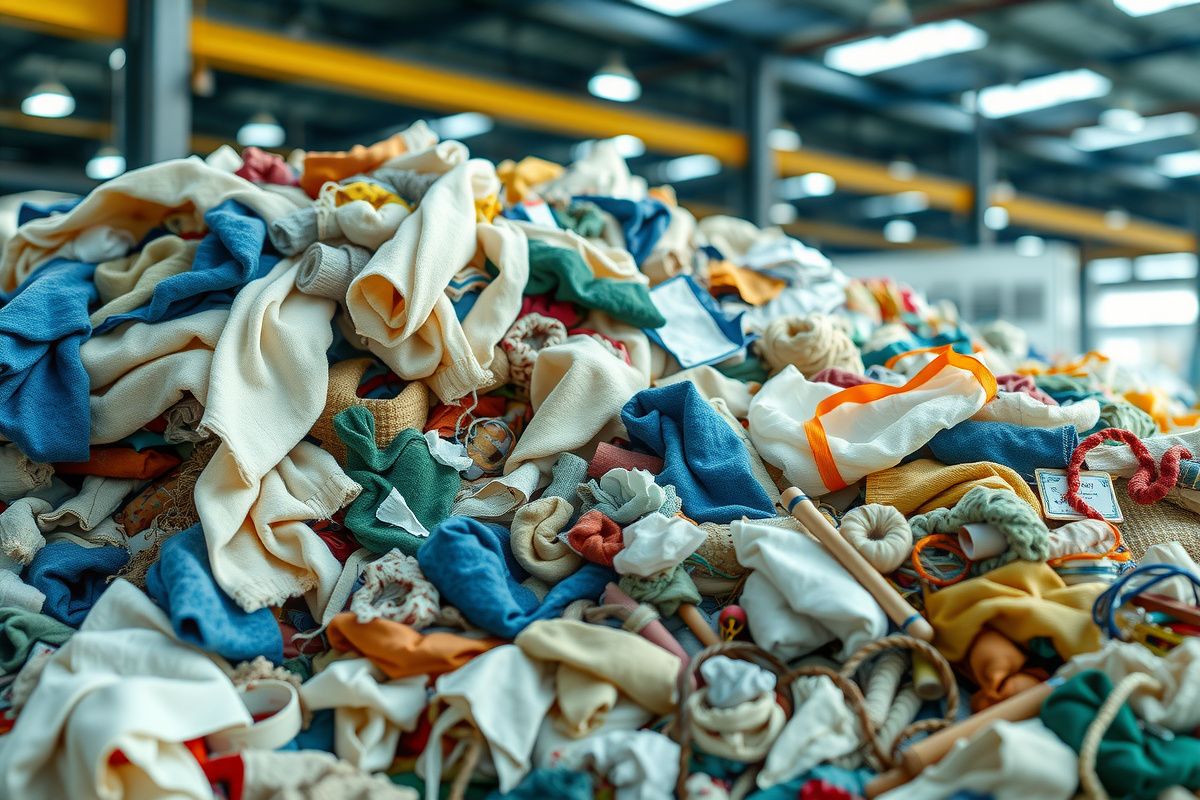
Industrial textile waste poses a significant environmental and economic challenge, as its volume continuously grows with the development of light industry and other sectors that use textiles. This waste includes fabric scraps, yarn remnants, used workwear, filter materials, and much more. Uncontrolled disposal of such materials leads to soil and water resource contamination, as well as significant greenhouse gas emissions during incineration or decomposition in landfills. That is why the recycling and reuse of industrial textile waste is not just desirable, but a critically important strategy for achieving sustainable development and a circular economy.
The urgency of this topic is also intensified by the growing demand for raw materials and energy resources. The reuse of textile materials reduces dependence on primary sources, lowers production costs, and minimizes the ecological footprint. UtilVtorProm actively develops and implements effective solutions for managing industrial textile waste, offering comprehensive services for its collection, transportation, storage, and processing. We understand that each type of textile waste has its unique properties and requires an individual approach to maximize the recovery of valuable components.
Diversity of Industrial Textile Waste and Its Morphological Composition
Industrial textile waste is characterized by an extraordinary morphological and chemical diversity, which is due to the wide range of its origins. It can include natural fibers such as cotton, flax, wool, silk, as well as synthetic materials – polyester, polyamide, acrylic, viscose, and their blends. This category also includes composite materials where textile fibers are combined with other components, such as polymer coatings or metal threads. The technical characteristics of the waste are determined by fiber length, strength, elasticity, hygroscopicity, as well as the presence of contaminants such as dyes, oils, chemical reagents, or dust. The principle of processing is based on mechanical, chemical, or thermal processes that allow components to be separated, cleaned, and prepared for further use.
Particular attention should be paid to the composition of the waste, as the presence of certain impurities can significantly affect the choice of processing method. For example, textile waste with a high content of synthetic fibers may be suitable for pyrolysis or chemical decomposition to obtain monomers, while natural fibers are more often subjected to mechanical processing for the production of recycled fibers or fillers. It is also important to consider physical properties such as density, volume, and degree of grinding, which affect transportation and storage. UtilVtorProm has significant experience in determining optimal strategies for managing various types of textile waste, ensuring their efficient and safe processing in accordance with environmental standards.
Innovative Applications of Secondary Textile Resources
Recycled textile waste finds wide application in various industries, which emphasizes its value as a secondary raw material. One of the key areas is the production of new textile products. Regenerated fibers can be used to make yarn for clothing, technical fabrics, upholstery materials, and furniture fillers. For example, shredded cotton waste is used to produce denim fabric or thermal insulation materials. Polyester waste can be converted into granules, from which new fibers are then extruded for fleece products, carpets, or even fillers for pillows and blankets.
In addition to the textile industry, secondary textile materials are actively used in construction, automotive, and agriculture. In construction, they are used as sound and thermal insulation materials, as well as additives to composite building mixtures. In the automotive industry, recycled textile fibers are part of sound insulation, interior upholstery, and panel elements. In agriculture, textile waste can be used as mulching materials or components for compost production. UtilVtorProm cooperates with enterprises in various industries, helping them integrate recycled textile materials into their production cycles and promoting the creation of more sustainable and environmentally responsible products.
Environmental Management of Industrial Textile Waste and Its Classification
Effective management of industrial textile waste requires strict adherence to environmental norms and standards. It is important not only to properly organize collection and transportation but also to ensure their proper classification. Industrial textile waste can be classified according to various codes of the National Waste List (NWL) depending on its origin, composition, and the presence of hazardous components. For example, textile waste containing hazardous substances, such as heavy metals or toxic dyes, is designated by code 04 02 16* (Dyes and pigments containing hazardous substances), or 15 02 02* (Absorbents, filter materials, wiping cloths and protective clothing contaminated with hazardous substances). Textile waste that does not contain hazardous components can be classified, for example, as 04 02 22 (Waste from finishing not otherwise specified in 04 02 14), or 15 02 03 (Absorbents, filter materials, wiping cloths and protective clothing not falling under 15 02 02). Correct code identification is critically important for selecting appropriate processing methods and ensuring environmental safety.
UtilVtorProm provides a full range of environmental services to enterprises, including consultations on textile waste classification, development of individual waste management plans, and organization of collection, transportation, storage, and processing. We ensure full compliance with all legal requirements and environmental standards. Our specialists have deep knowledge in the field of waste management and use modern technologies to minimize the negative impact on the environment. We strive to ensure that every stage of working with textile waste is as efficient and safe as possible, contributing to the sustainable development of industry and the preservation of natural resources for future generations.
Professional Partnership with UtilVtorProm for Textile Waste Processing
Cooperation with UtilVtorProm guarantees a professional and responsible approach to industrial textile waste management. We possess all the necessary licenses and permits to carry out activities for the collection, transportation, storage, and processing of various types of waste, including textiles. Our team of experts develops individual solutions for each client, taking into account the specifics of their production and the volumes of waste generated. We use modern equipment and advanced technologies that allow us to process textile materials as efficiently as possible, reducing their volume in landfills and returning valuable resources to economic circulation. By contacting UtilVtorProm, you get a reliable partner who will help your enterprise meet the highest environmental standards and implement the principles of a circular economy. We invite you to contact us for a detailed consultation and to develop an optimal plan for managing your industrial textile waste.