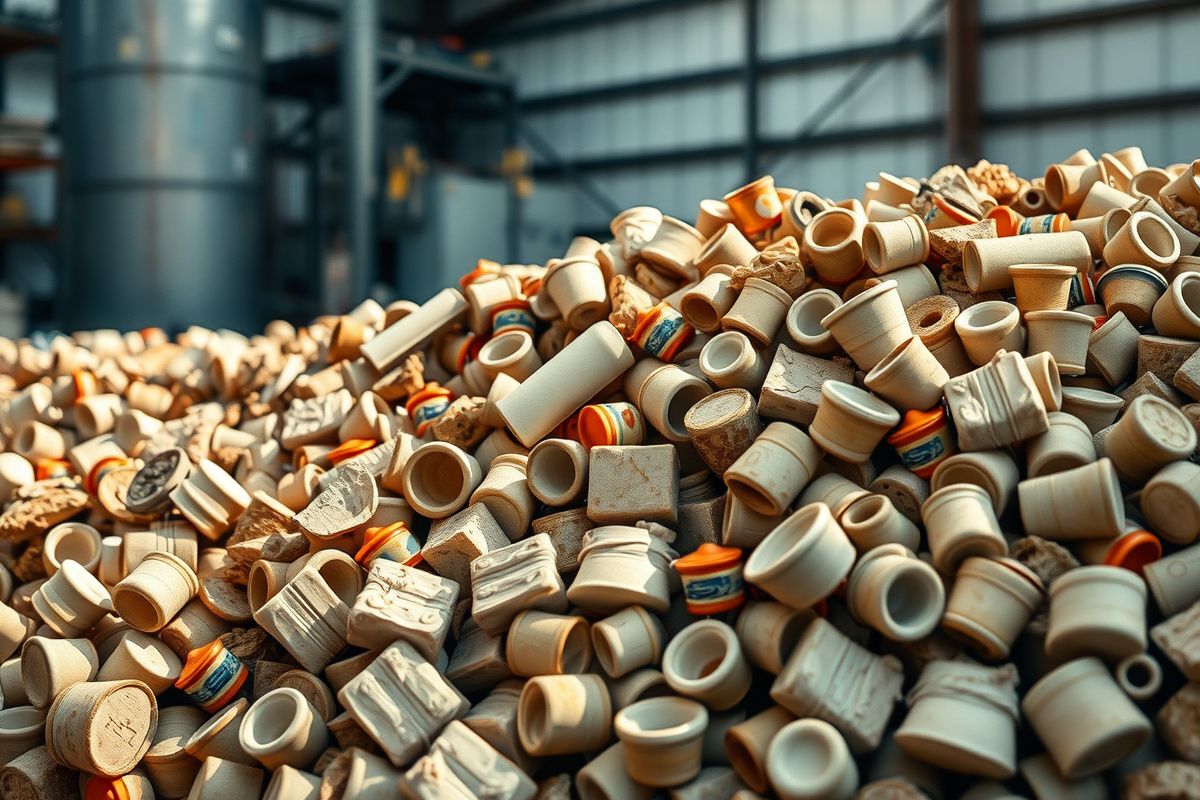
The recycling and reuse of industrial ceramic waste is an extremely relevant topic for modern industry, which strives for sustainable development and minimizing negative environmental impact. The growing production of ceramic products, from building materials to high-tech components, inevitably leads to the formation of significant volumes of waste. These wastes, if not properly processed, can occupy large areas in landfills, pollute soils and water resources, and deplete natural raw material deposits. Therefore, effective strategies for managing ceramic waste become not just desirable, but critically necessary for economic and environmental stability.
UtilVtorProm, as a leader in the field of environmental services for enterprises, pays special attention to the development and implementation of innovative solutions for the recycling and reuse of industrial ceramic waste. This allows not only to reduce the volume of waste sent to landfills, but also to create new valuable materials, save energy, and reduce production costs. Thanks to a comprehensive approach and the application of advanced technologies, we help enterprises comply with the strictest environmental standards and achieve high environmental performance indicators, contributing to a circular economy and responsible resource consumption.
Technical aspects of ceramic waste processing
Industrial ceramic waste, depending on its origin, can have different compositions and physicochemical properties. These include fragments of bricks, tiles, faience, porcelain, sanitary ware, as well as waste from the production of technical ceramics and refractories. The main components of ceramic materials are oxides of silicon, aluminum, iron, calcium, magnesium, and potassium. These materials are characterized by high strength, hardness, resistance to chemical influences, and high temperatures. However, these very properties complicate their processing, requiring special equipment and technologies. The recycling process usually includes stages of crushing, grinding, sorting, and, if necessary, thermal or chemical treatment to obtain secondary raw materials with specified characteristics.
The quality of secondary ceramic raw materials largely depends on the efficiency of the grinding process. Modern technologies use rotary and jaw crushers, ball mills, and vibrating screens to achieve the required degree of dispersion. After grinding, the material can undergo magnetic separation to remove metallic impurities and air or water separation to separate fractions by size and density. An important stage is also quality control of the obtained secondary material, which must comply with certain standards for further use in production. The application of these technologies allows converting potentially harmful waste into valuable resources, which is the basis for sustainable industrial development.
Application of secondary ceramic raw materials in industry
Recycled ceramic waste finds wide application in various industries, which emphasizes its value as a secondary raw material. One of the most common areas is the construction industry, where crushed ceramic cullet is used as an aggregate for concrete, asphalt concrete, and building mortars. It improves the thermal and sound insulation properties of materials, reduces their density, and lowers raw material costs. In addition, ceramic waste is used for the manufacture of road surfaces, drainage systems, and as a backfill material for the construction of roads and sites. This allows for efficient use of resources and reduces the burden on natural deposits, ensuring economic benefits and environmental responsibility.
Other industries also actively integrate secondary ceramic raw materials into their production processes. For example, in the production of new ceramic products, such as bricks, tiles, porcelain stoneware, the addition of crushed waste can improve the properties of the final product, reduce firing temperature, and decrease energy consumption. In foundry production, ceramic waste can be used as components of molding mixtures, and in horticulture and landscape design – as a decorative material or to improve soil drainage properties. Such diverse application demonstrates the huge potential of ceramic waste as a resource that can be integrated into the circular economy, contributing to the preservation of natural resources and waste reduction.
Proper handling of industrial ceramic waste
Proper handling of industrial ceramic waste is a key element of environmental safety and compliance with legislative norms. According to the National Waste List (NWL), ceramic waste is classified under various codes, depending on its origin and the presence of hazardous components. For example, waste concrete, bricks, tiles, and ceramics that do not contain hazardous substances can be classified as 17 01 07. However, if the waste contains hazardous substances, its coding may be different, for example, 17 01 06* for mixtures or separate fractions of concrete, bricks, tiles, and ceramics containing hazardous substances. It is important to remember that an asterisk (*) indicates hazardous waste that requires special conditions for collection, transportation, and processing. UtilVtorProm provides a full range of environmental services for enterprises, including identification, classification, and safe handling of all types of ceramic waste, ensuring compliance with all regulatory requirements.
The procedure for handling ceramic waste includes several stages: collection, temporary storage, transportation, and direct processing or disposal. It is important to ensure separate collection of waste at its point of origin to avoid mixing with other types of waste and simplify further processing. Temporary storage should be carried out on specially equipped sites that prevent environmental pollution. Waste transportation is carried out by specialized transport that has appropriate permits and licenses. UtilVtorProm guarantees full compliance of all stages of ceramic waste handling with current legislation, minimizing risks to the environment and the company's reputation. We help our clients implement best practices in waste management, ensuring environmental safety and economic efficiency.
Professional partnership with UtilVtorProm in ceramic waste management
Cooperation with UtilVtorProm on industrial ceramic waste management issues is a guarantee of your peace of mind and confidence in compliance with all environmental standards. We have many years of experience and all the necessary licenses for carrying out activities for the collection, transportation, storage, and processing of various types of waste. Our team of professionals provides an individual approach to each client, developing optimal solutions that take into account the specifics of production and the type of waste generated. We will help you not only dispose of waste but also integrate the principles of a circular economy into your activities, transforming waste into valuable resources. Contact us today to get a consultation and discuss the possibilities of efficient and environmentally safe processing of your ceramic waste.