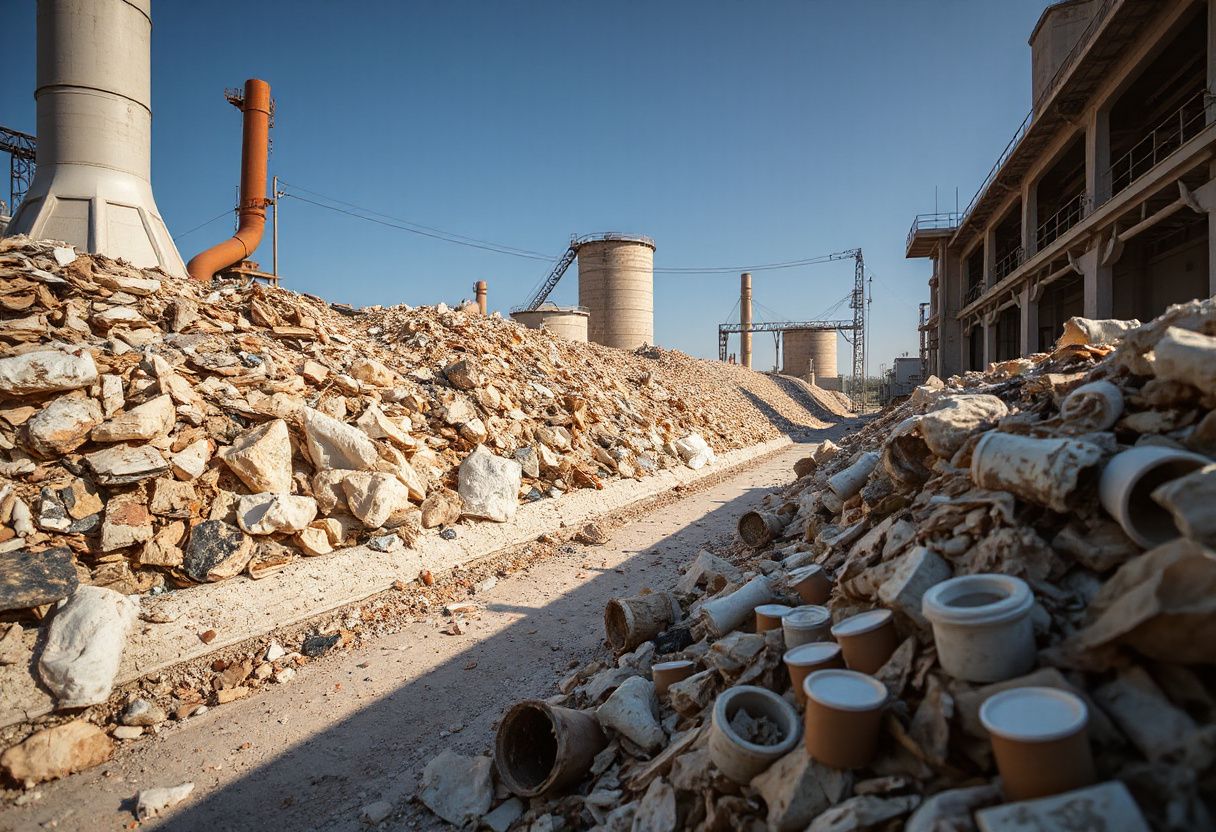
The accumulation of fiberglass residues and uncured resins at sites creates a high fire and sanitary hazard. Fine glass dust enters the respiratory tract of workers and settles in the ventilation ducts of workshops. Uncontrolled mixing of toxic binders with household waste leads to chemical pollution of soil and underground aquifers with persistent polymers. Epoxy and polyester components release styrene and phenol even at room temperature. Long-term storage of such scraps without special sealed containers provokes spontaneous combustion of volatile fractions, although the binding materials seem completely cured. Enterprises suffer heavy losses due to line shutdowns and fines from the environmental inspection during scheduled inspections.
Thermal Decomposition and Rotor Trimming in Wind Energy
The generation of fiberglass waste occurs mainly at the stages of fiberglass cutting, vacuum infusion, and machining of finished composite elements. During the manufacture of wind turbine blades or boat hulls, up to 20% of the raw material turns into unusable defective chips or edge trimmings. Violation of the hardener proportions when pouring parts leads to the solidification of monolithic arrays directly in the mixers. Technological scrap cannot be remelted because thermosets do not become liquid under the influence of high temperature due to the thermosetting network.
Worn filter bags and dust collector protective membranes also pose a serious problem. Dust settles on internal components. These microscopic fibers block the operation of ventilation systems and deform moving parts of machine tools. Cleaning dry filters requires maintaining tightness and using special closed screw conveyors. Although dry pyrolysis remains effective for extracting clean fiber, this method requires significant energy consumption to heat the chamber to 500 °C.
Chemical Composition of E-glass Fiberglass Materials
Hazardous Substances in the Composition of Binder Resins
Fiberglass consists of E-glass reinforcing glass fiber and a polymer matrix based on epoxy or polyester compounds. Plasticizers, sizing agents, flame retardants, and hardeners based on aliphatic amines or maleic anhydrides are added to the product. The glass yarn has high tensile strength and temperature resistance up to 550 °C. However, the organic part decomposes when heated above 250 °C with the release of carbon monoxide, toxic aldehydes, and aromatic hydrocarbons.
Residues of uncured resin retain high chemical activity for several months. Contacting moisture and oxygen, these compounds release volatile harmful vapors into the environment. Solid composite fragments exhibit biological inertness, but when crushed, they form fine dust with a particle size of less than 5 microns. Although mechanical crushing facilitates transportation, it creates the danger of an explosion of a dust-air mixture in a confined space.
Classification by Codes 10 11 12* and 07 02 14* according to the National List of Wastes
According to the National List of Wastes, glass fiber manufacturing wastes are classified under code 10 11 12* for hazardous fractions. Code 07 02 14* corresponds to residues of liquid epoxy or polyester resins, denoting waste from the use of organic chemicals. Regulations require separate accumulation. The enterprise is obliged to ensure proper accounting of each batch, since mixing hazardous substances with safe materials is strictly prohibited by the legislation of Ukraine.
Methods of Incineration in a High-Temperature Furnace at 1200 °C
Ecological treatment of technological composite residues requires the use of multi-stage high-temperature incineration technologies. In an incinerator furnace at a temperature of 1200 °C, the organic matrix is completely oxidized into safe gases. The modern enterprise UtilVtorProm performs a full range of works on the removal, sorting, and thermal treatment of toxic waste using licensed equipment. The determined slag residue after incineration is used as an additive in cement production. If the sorted fraction contains metal elements, it is pre-separated on powerful magnetic installations for the subsequent extraction of scrap metal.
To build a safe system for handling industrial fiber residues, it is necessary to conduct an initial audit and install specialized containers. UtilVtorProm accepts applications for the removal of complex composite materials and provides a full range of work according to an agreed schedule.