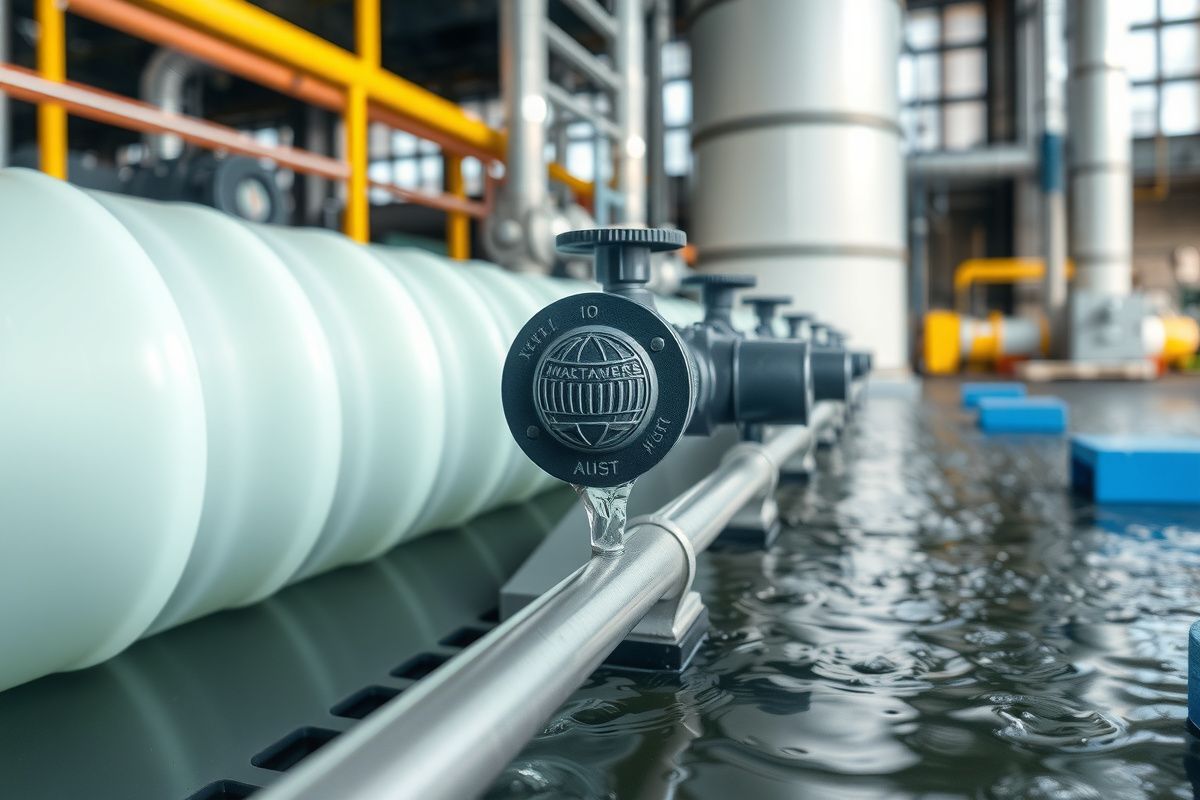
Rising environmental standards and the urgent need to conserve water resources demand that industrial enterprises develop and implement highly efficient wastewater treatment methods. Membrane technologies are among the most promising and powerful tools in this field, not only ensuring compliance with strict regulations but also opening up opportunities for the reuse of treated water and valuable components. Their ability to remove a wide range of pollutants, from mechanical to dissolved, makes them indispensable in the modern industrial sector, where issues of sustainable development and minimizing negative environmental impact are paramount. The application of membrane systems significantly reduces discharge volumes, decreases fresh water consumption, and enhances the overall environmental responsibility of an enterprise.
The relevance of membrane technologies is also amplified by the increasing complexity of industrial wastewater composition, which often contains mixtures of organic and inorganic compounds, heavy metals, and other toxic substances. Traditional treatment methods cannot always effectively cope with such challenges, whereas membrane processes offer deeper and more reliable purification. This is particularly important for industries where the quality of discharged water is critical or where there is a need for closed-loop water usage. Thanks to their versatility and high efficiency, membrane systems are becoming the foundation for innovative solutions in water treatment and wastewater purification, contributing to the sustainable development of industry and the preservation of natural resources for future generations.
Principles of Operation and Efficiency of Membrane Treatment Systems
Membrane technologies are based on the process of selective separation of solution components under the action of a driving force, most often pressure, through a semi-permeable barrier – a membrane. Depending on pore size and separation mechanism, several main types of membranes are distinguished: microfiltration (MF), ultrafiltration (UF), nanofiltration (NF), and reverse osmosis (RO). Microfiltration removes large particles and suspensions, while ultrafiltration is effective against colloids, macromolecules, and bacteria. Nanofiltration can retain divalent ions and small organic molecules, and reverse osmosis provides the highest degree of purification, removing most dissolved salts, viruses, and low-molecular-weight organic compounds, making it key for obtaining high-purity water. Membranes are made from various polymeric materials, such as polysulfone, polyethersulfone, cellulose acetate, or ceramics, which ensures their chemical resistance and durability.
The operating principle of membranes lies in a physical barrier that allows water molecules to pass through but retains larger pollutant molecules. System efficiency depends on operating pressure, temperature, pollutant concentration, and the properties of the membrane itself, including its material, pore size, and hydrophilicity/hydrophobicity. Important characteristics also include flux, which determines system productivity, and selectivity, which indicates the membrane's ability to retain certain components. These systems are distinguished by their high efficiency in removing organic substances, heavy metals, salts, and microorganisms, ensuring the quality of treated water, which often allows its reuse in production processes. Thanks to their energy efficiency and minimal use of reagents, membrane technologies are an environmentally advantageous solution for the comprehensive treatment of industrial effluents.
Widespread Use of Membrane Technologies in Industrial Water Treatment
Membrane technologies find application in a wide range of industrial sectors where highly efficient wastewater treatment is required. In the chemical and pharmaceutical industries, they are used for concentrating valuable components, separating mixtures, and purifying wastewater from organic solvents and reagents. For example, in metallurgy, membrane systems are used for treating pickling solutions, removing heavy metals, and regenerating water. In the food industry, particularly dairy and juice production, membranes are used for clarifying juices, concentrating milk and whey, and purifying wash waters. In the textile industry, membrane units effectively remove dyes and other organic pollutants from process effluents, allowing water reuse. Similar to the analysis of fly ash from emulsified hydrocarbon combustion, where precise identification of components is important, membrane technologies ensure high accuracy in the separation and concentration of substances in wastewater.
Examples of equipment include spiral, tubular, or hollow-fiber modules, which are integrated into complex treatment systems. Such systems can be autonomous or combined with other methods, such as biological treatment, coagulation, and sorption, to achieve maximum effect. In the oil refining industry, membranes are used for treating produced water and removing petroleum products. The ability to obtain high-quality water allows enterprises to implement closed-loop water supply systems, significantly reducing fresh water consumption and the discharge of contaminated effluents into natural water bodies. This not only complies with environmental requirements but also provides economic benefits by reducing water supply and wastewater disposal costs, highlighting the significant potential of membrane technologies for sustainable industrial development.
Ecological Management of Membrane Filter Waste
After prolonged operation, membrane filters, as well as the concentrates formed during the purification process, become waste that requires specialized handling. Spent membranes, especially those used for treating aggressive or toxic effluents, may contain hazardous substances that have been retained in the pores or on the surface. These wastes can be classified according to the National Waste List (NWL) under codes that reflect their composition and degree of hazard. For example, spent filtering materials containing hazardous substances may fall under code 15 02 02*, while other alternative fractions containing hazardous substances may be classified as 19 02 04* or 19 08 11* if they are a result of physicochemical wastewater treatment. Concentrates formed as a result of membrane purification also often contain high concentrations of pollutants and can be classified as hazardous waste, similar to how alternative wastes of this category are handled. UtilVtorProm company provides comprehensive services for the environmental maintenance of enterprises, including collection, transportation, storage, and processing of such wastes.
Improper handling of spent membranes and concentrates can lead to significant environmental pollution, including soil and water bodies, as well as administrative and criminal liability for the enterprise. Therefore, it is extremely important to entrust the handling of such specific wastes to licensed specialists. UtilVtorProm company has all the necessary permits and many years of experience in hazardous waste management. We ensure safe and environmentally responsible collection, transportation, and further processing of spent membranes and concentrates, minimizing their impact on the environment. Our services include the development of individual solutions for each enterprise, taking into account the specifics of its production and the composition of the generated waste. This allows enterprises not only to comply with legal requirements but also to contribute to sustainable development, similar to the importance of ensuring the safe handling of cytotoxic and cytostatic medicines, which are also hazardous wastes.
Professional Partnership with UtilVtorProm for Environmental Safety
UtilVtorProm company is a reliable partner for industrial enterprises in the field of environmental services and waste management generated as a result of membrane technology application. We offer a professional approach to each client, developing individual solutions that comply with all regulatory requirements and standards. Our activities are licensed, which guarantees the legality and safety of all stages of work: from collection and transportation to storage and processing of hazardous waste, including spent membranes and concentrates. We do not sell products but provide services aimed at protecting the environment and ensuring the ecological safety of your enterprise. We invite you to cooperate with UtilVtorProm to ensure effective and responsible management of industrial waste, minimizing environmental risks and optimizing production processes. Contact us to learn more about our services and get expert consultation.