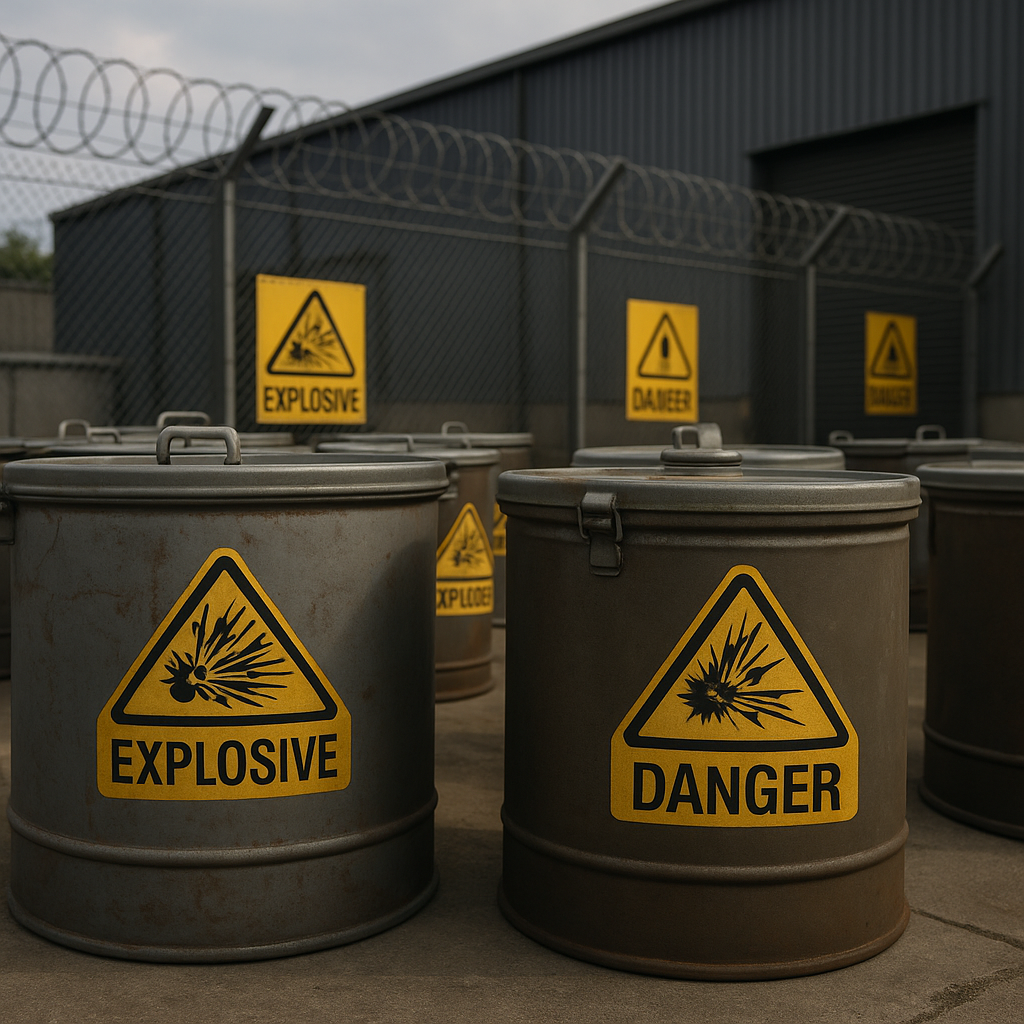
Other explosive waste (codes 16 04 03*, 16 12 49*) represents one of the most dangerous categories of hazardous materials due to their high energy, chemical instability, and detonation risk.
Comprehensive hazardous waste management in this field requires specialized technologies and continuous monitoring of explosive residues.
Main types of such waste include:
- remnants of explosive mixtures from production;
- defective charges or detonators;
- unstable gunpowder components;
- reaction mixtures after testing or experiments.
Safe handling of hazardous waste of explosive type is based on minimizing human contact with potentially active substances.
During environmental servicing of enterprises working with explosives, every batch must be recorded, storage terms monitored, and facilities regularly inspected.
Hazardous waste storage of this type is carried out in separate reinforced concrete or underground facilities equipped with humidity, temperature, and ventilation control systems.
During hazardous waste transportation, armored or reinforced containers must be used, and routes approved by relevant authorities.
Modern hazardous waste processing of explosive materials focuses on neutralizing components without detonation risk and recovering useful substances for technical reuse.
Main processing methods include:
- chemical or thermal decomposition of explosive mixtures;
- controlled incineration in isolated chambers;
- neutralization using special reagents.
Such operations must only be performed by trained personnel licensed to work with explosive materials.
Particular attention is given to surveillance systems, alarms, and emergency notifications that provide 24-hour monitoring.
Automated monitoring systems help detect pressure or temperature changes that may indicate a reaction.
Integrating enterprise environmental servicing processes into explosive waste management systems reduces industrial accident risks and enhances ecological safety.
Explosive waste management requires not only technical discipline but also a culture of responsibility at every stage — from transport to final neutralization.